
After 30 years of waiting, Liverpool won the English Premier League (previously English First Division) ending a drought in the domdestic division. There was no doubt since December about how Liverpool was the team to catch up for the title and they won it with 7 games left in the league. A record not achieved by any teams before.
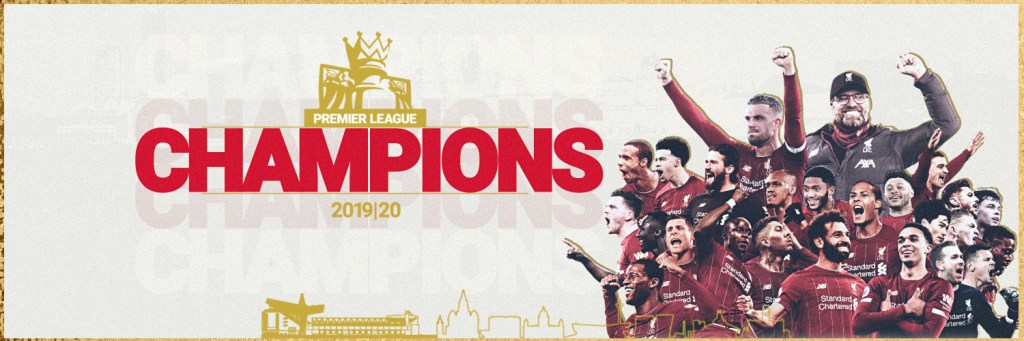
But if you were to ask Liverpool in 2015 whether Liverpool would win a league in 4 years’ time even the most optimistic Liverpool fans would have taken a long hard thought before delivering their verdict. What changed for Liverpool after losing out on a title race to City in 2014 ? Liverpool fans would say it was the coming off Jurgen Klopp to Liverpool.
A.C.Milan’s last major trophy came via the Scudetto win in 2011 and ever since then the decline has been so steep that we have seen droves of managerial changes and millions being invested in resurrecting the club. When quizzed about the club’s approach by Gazetta Dello Sport Gazidis had to say this “Liverpool spent nine years in a situation similar to ours. When Klopp arrived, he said he would make the sceptics believe; no one believed it at the beginning, not even the fans. Today, we can see what Liverpool are. Soon, you will see what Milan are.”
So what features can Milan take from Liverpool and apply it on their blueprints ? With this article we take a look at the various lessons Milan can inculcate from Liverpool as well as the similarities being brought about with the appointment of Rangnick starting with a tactical analysis.
TACTICAL ANALYSIS
History
In 1983 when legendary coach Valeriy Lobanovskyi and his all-conquering Dynamo Kyiv came to a small town in Germany called Wuttenberg to play a friendly against a local team Viktoria Backnang their coach was none other than Ralf Rangnick. Along with Helmut Gross who were 10 years apart both Gross and Rangnick were fascinated with Zonal marking and ball oriented defending which were first brought about by teams in USSR (now Russia) and occasionally came up through Ernst Happel. So when the ball went out for a throw in during one of Kyiv’s practice matches Rangnick stopped to count the number of players per each side, sure that Dynamo Kyiv had inserted an extra man in between the match. What Rangnick saw was intense pressing which was then successfully interpreted and applied by Milan’s very own Arriggo Sacchi. At a time when catenaccio was still rife in Italy, Sacchi discovered and applied Zonal Marking and Ball-oriented defending while taking advantage of the offside rule present at the time. While Helmut Gross was the brain behind Gegenpress, Ralf Rangnick was the general who introduced change in German football a time when they refused to accept pressing. Now German teams are the harbingers of the press and counter press tactics popularly known as Gegenpress.
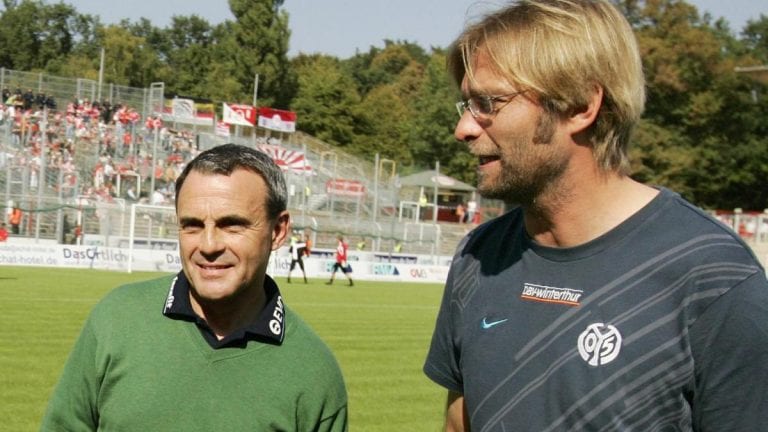
Fast Forward to 1995, Mainz appointed a relatively unknown figure called Wolfgang Frank as their coach when they were struggling in the second division. Frank was another staunch follower of Milan coach Arrigo Sacchi and he started applying Sacchi’s style of play in Mainz. Mainz’s Centre back was none other than modern day genius Jurgen Klopp who would imbibe these tactics and applying with varying degrees at Dortmund and Liverpool
Gegenpress (Defensive Transition)
Gegenpress is all about intense physical pressing when the team loses possession of the ball. When either one of Klopp or Rangnick’s team loses the ball they press the opposition player in possession of the player and force him to either concede possession or make an inaccurate pass forward. They tend to take advantage of the momentary disorganization while turnover of possession happens.
The player who has won the ball back might have spent energy in winning the ball back and hence would be tired momentarily and hence when pressed could be forced into a mistake. A mistake could also arise from the time taken to touch the ball and get into control and once again pressing works. Let us look at the similar facets employed by Rangnick and Klopp
Triangle Pressing
Now let us look at how teams Klopp’s and Rangnick’s team press for the ball.
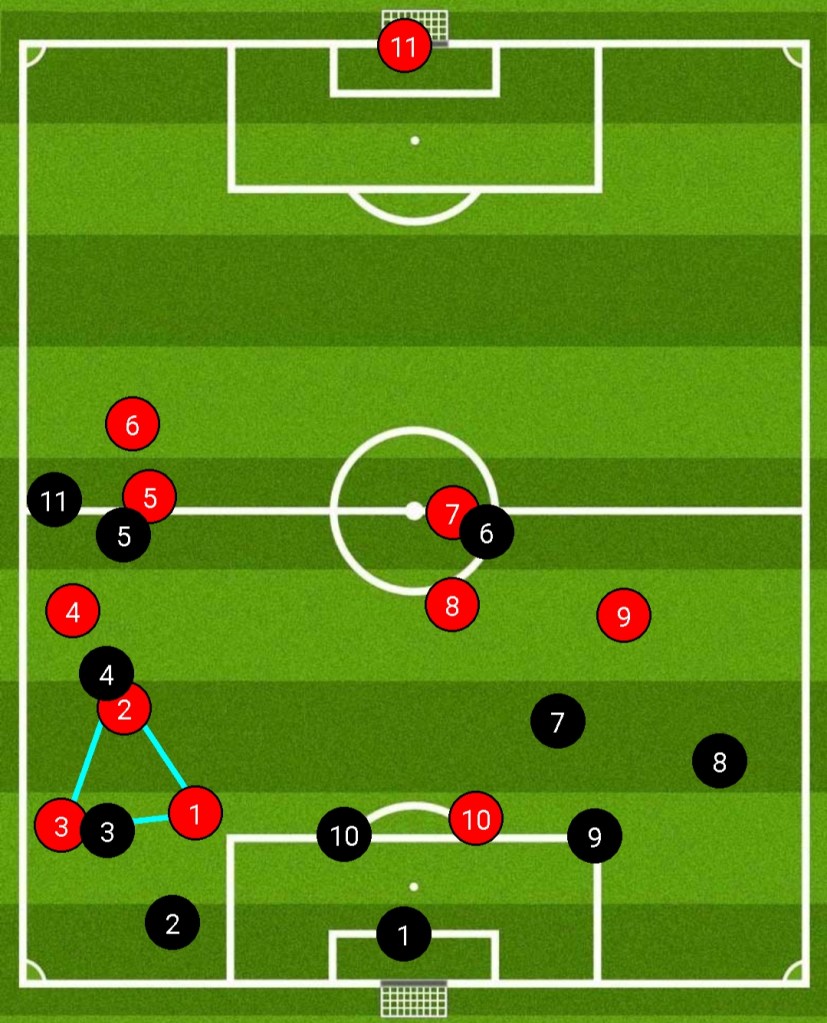
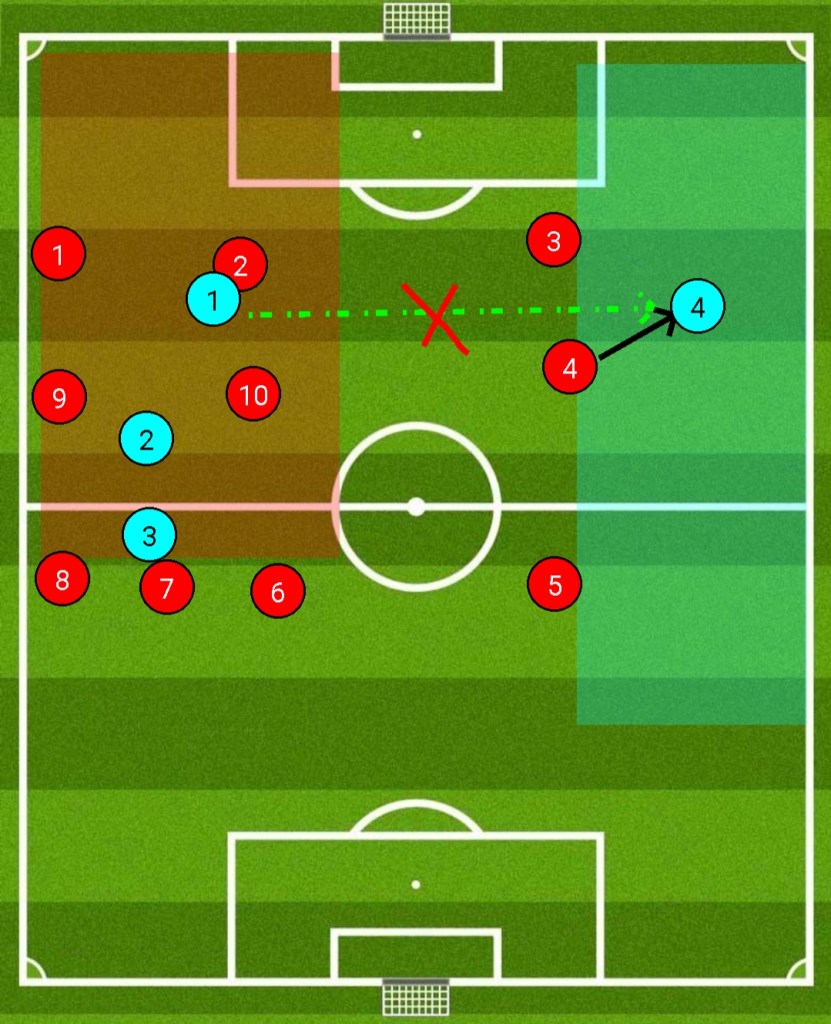
This picture was of a match between Liverpool and Arsenal at Anfield (jersey numbers are not in order). In this particular press which happens at Arsenal’s left flank and consequently Liverpool’s’ right flank you can see how player no.3 who is in possession of the ball is being pressed by player no.3 of Liverpool while player no.1 and 2 cut off the passing lanes for the Arsenal player. By taking up these formations they form a smart triangle.
In Rangnick’s time at Hoffenheim, which was the only time he played a 4-3-3 (otherwise preferred 4-4-2 or 4-2-2-2) Rangnick used aggressive play to press the player in the center of the pitch by forcing the opposition to play in the center whose mechanism we will look in the coming sections.
Horizontal Pressing
Klopp has been Guardiola’s Kryptonite in the premier league and the main reason for this is how Klopp has been flexible with his press and forcing Manchester city out of their comfort zones.
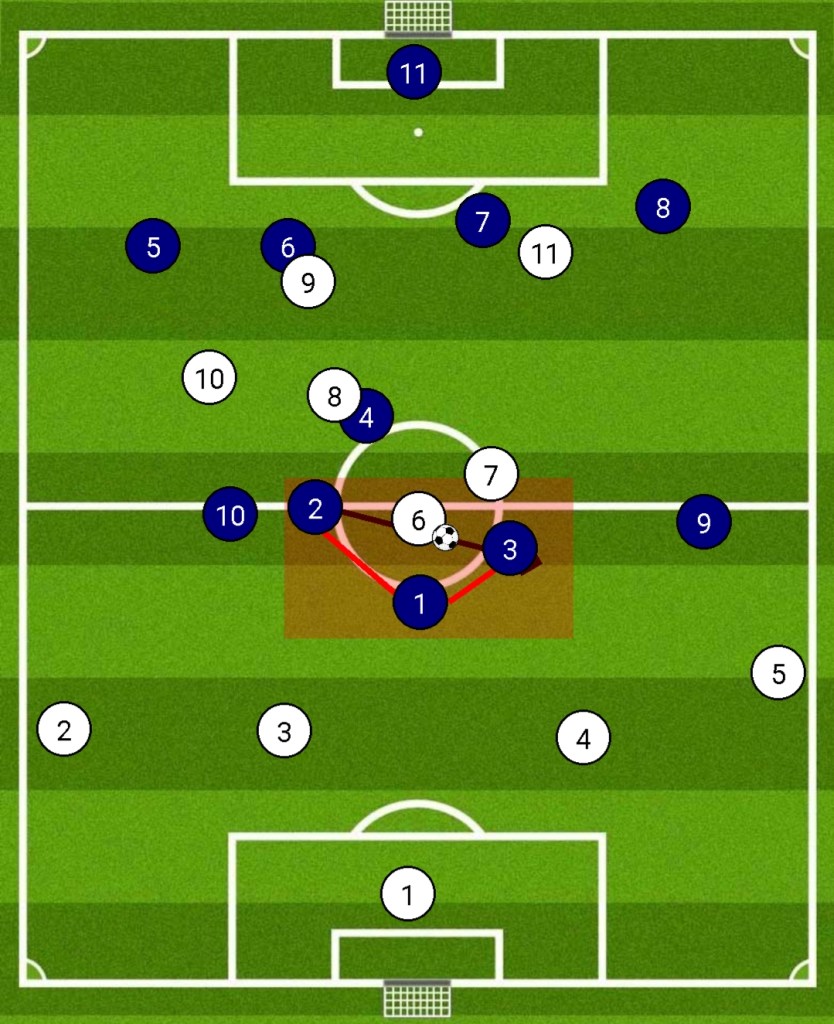
In Liverpool’s 4-3 win over city at Anfield and in their subsequent champions league quarter finals, Klopp had his last line of defenders (player no. 8,7,6,5) move horizontally whenever the ball was with the full backs while his second line of defence (no.9,10) moved vertically and cut off all passing lanes for Walker (player no.1 in blue). This, while he was being pressed by firminho (player no.2 in red) and Mane (player no 1 in red). Walker had no other option either to go back to Ederson or play a risky long ball towards the centre of midfield to a waiting sterling or de bruyne which could see him concede possession. If Walker tried to switch play to Citys’s left back (player no.4) he would be cut off by Liverpool’s no.4. If Manchester city tries to go through the middle then their midfielders (Can, Chamberlain and Milner) would form a narrow wall in the center. In Liverpool’s Champions league QF win over city they used this tactic against Laporte who was a makeshift Left back who isn’t as comfortable on the ball as Mendy or a regular left back.
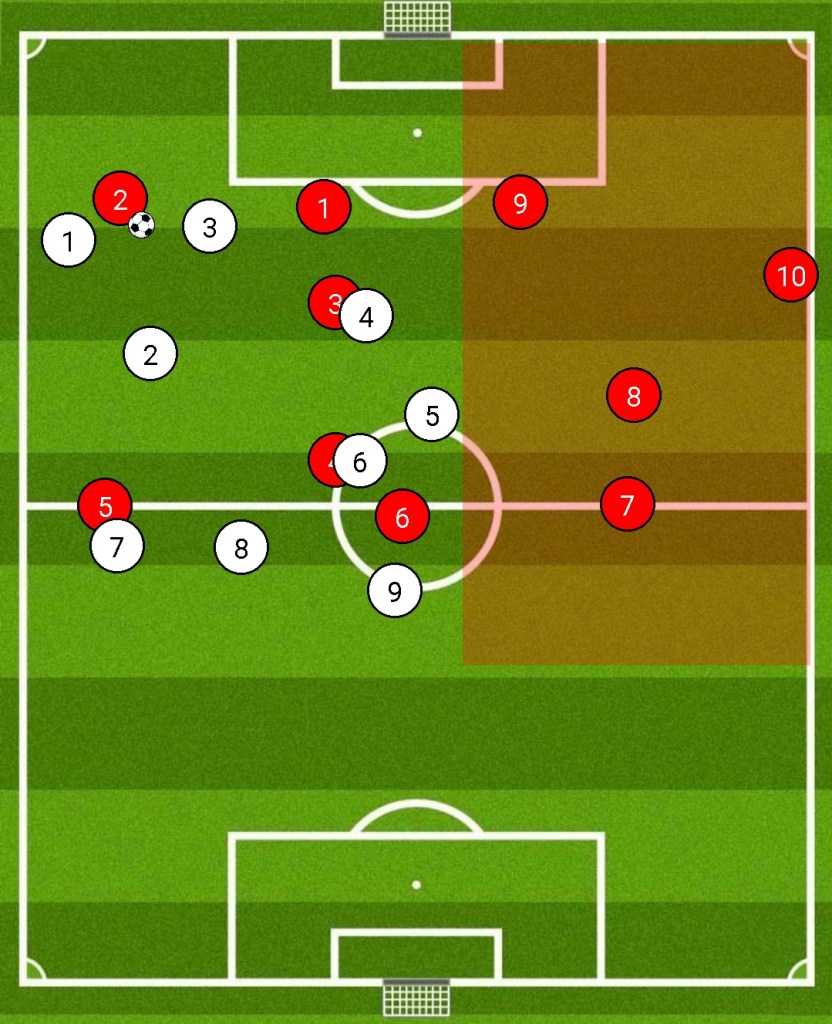
You can see how Ralf albeit using a 3-5-2 formation in his brief time at Leipzig uses the horizontal press Klopp uses at Liverpool.
Pressing Triggers
Klopp and Rangnick uses certain pressing triggers as they cannot wait, especially against more quality sides, to win the ball back. So they uses certain contextual clues or “pressing triggers” as it is called to force the opponent into making mistakes and winning the ball back

In the same game Liverpool won 4-3 vs Manchester city, they took advantage of Fernandinho who is less technical than De Bruyne and Davild Silva in the midfield. In this sequence above you can see how Walker (player no.4) who was player a square pass by City’s defender (player no.5) triggered a press. Walker in turn is being pressed by Mane (player no.11) of Liverpool while Firminho presses player no.5 to cut off his passing options of passing to Ederson or the centre back. Fernandinho then makes himself available and when he receives the ball he gets pressed up by Player no.6. and loses possession as de Bruyne and David Silva are too advanced to ease Fernandinho off the press.
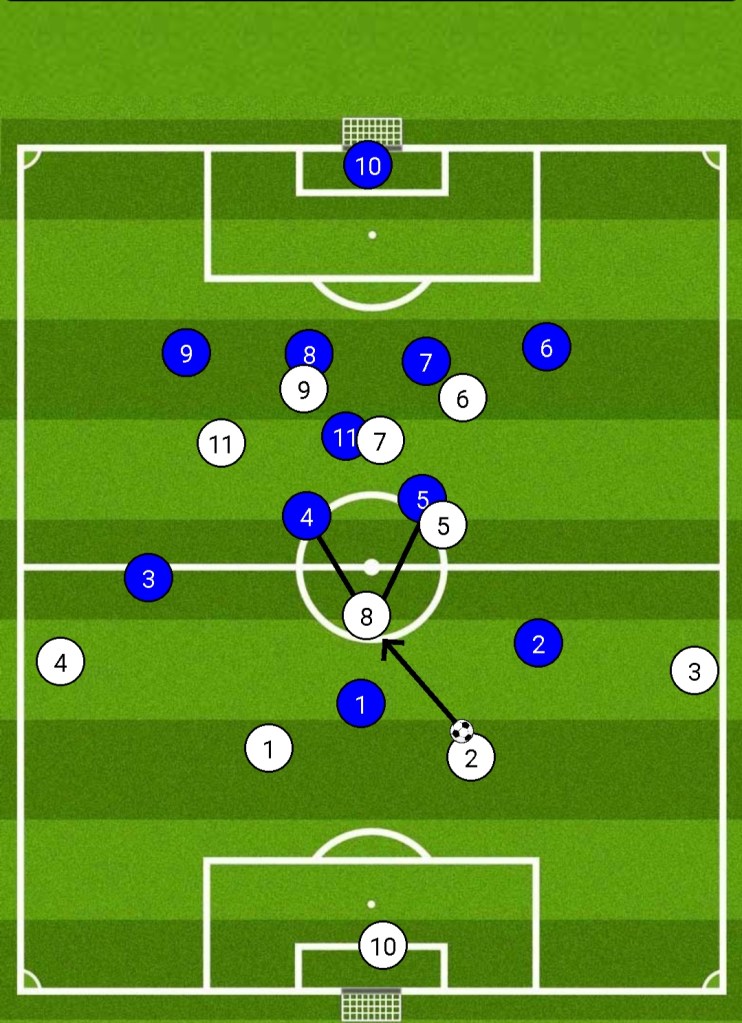
A similar situation can be seen here with Rangnicks team Hoffenheim. When the opposition played square passes between the centre back’s (no.1 & 2) Hoffenheims’s forward players press forward and block all passing lanes to the wings and force the centre backs to pass to the central midfielder in the middle (player no.8) who in turn is counter-pressed by Hoffenheim players no.4 and 5 and a turnover of possession occurs.
ATTACKING PHASE
As explained earlier Gegenpress is taking advantage of momentary disorganization of the oppositions and finding gaps. Rangnick emphasizes it with his 10 second rule, where he believes the best time to score a goal is within 10 seconds of winning the ball back from the opposition.
Overlapping FBs
In Liverpool’s champions league semifinal vs Barcelona, Klopp had his wide midfielders tuck inside inside and a central overload. This made Barcelona players to stay central in order to cover all passing lanes available to the players present in the centre. Klopp then had his full backs push up the flanks and make overlapping runs and always finding the space.
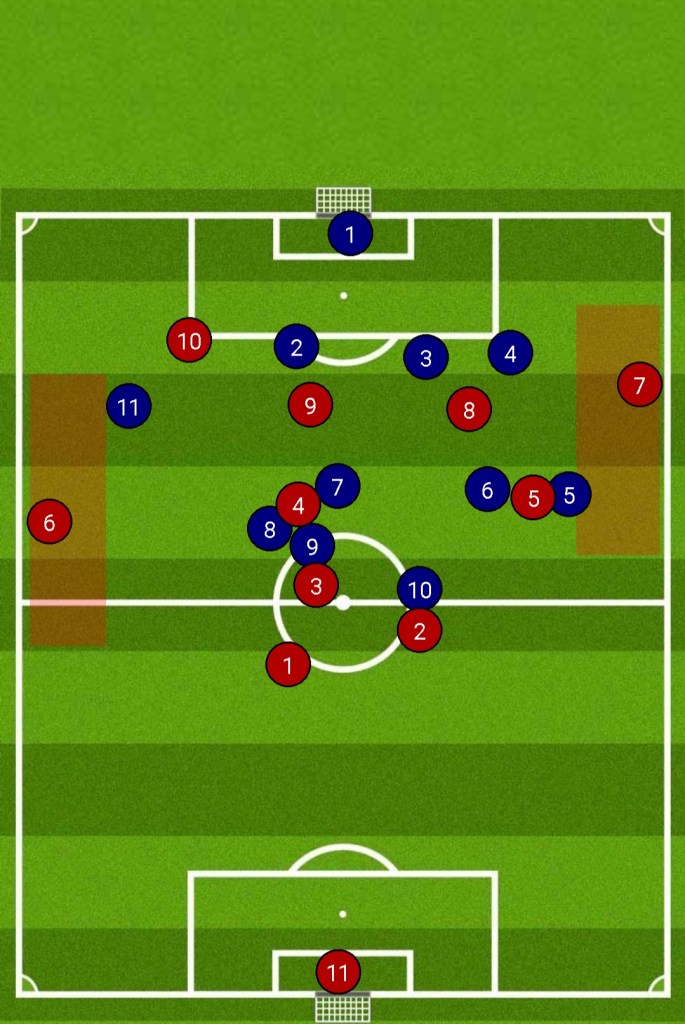
Ralf Rangnick also uses a similar approach. In his days as Leipzig manager where he used a 4-2-2-2 formation he had his wide midfielders tuck inside and create a hexagon in the centre creating a central overload. This was exploited by overlapping full backs.
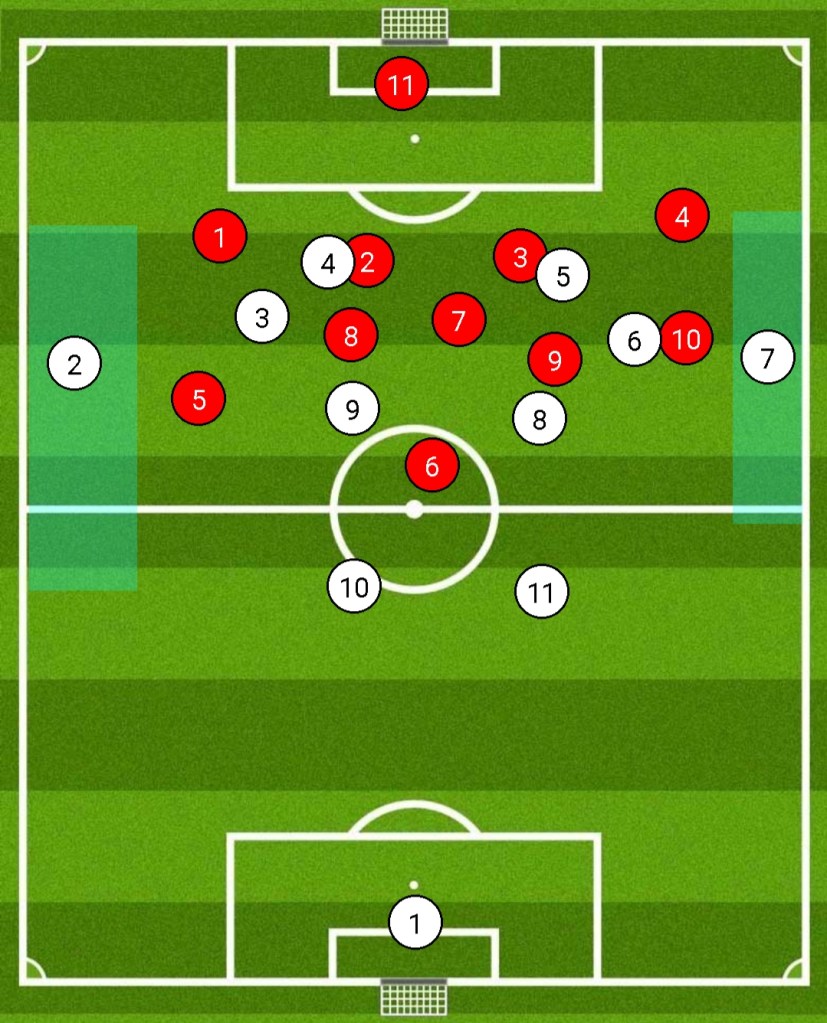
However in terms of Build-up and attacking play there are some significant differences. While Rangnick prefers a 2 striker approach and have his wide midfielders tuck in, Klopp has Firminho play as a false 9. Firminho plays in the Centre and has him dropping off into midfield allowing Salah and Mane to make deep runs. Sometimes Firminho even pulls a defender out of positions causing momentary gaps in defense which will exploited by the wingers making runs with midfielders making quick vertical passes.
Klopp also uses horitzontal passes in buildup play to spread the play out wide to his advancing full backs. Rangnick however prefers to play narrow and uses quick interplay to advance forward. He believes that horizontal passes are a waste of time in his reference to his 10 second rule.

While there are a few differences in their methodology the crux of both their ideologies are essentially all about Gegenpress. While Rangnick was the first advocate of Gegenpress, Klopp made it a global phenomenon with his success at Liverpool and Dortmund.
TECHNOLOGY
When Liverpool were in the search for a new manager after sacking Brendan Rodgers due to a dismal run, Liverpool turned to Jurgen Klopp who was known for his exploits with Borussia Dorrtmund. But his career had taken a hit, after his last season at Dortmund where he was fighting relegation in December but salvaged the season with a 7th placed finish. So when the Liverpool board was going through various names for the coaching spot, Research executive Ian Graham put in a case for Jurgen Klopp. With the use of data science and stats he argued that Klopp’s Dortmund the previous season had created far more chances than his opponents but were unlucky not to convert them into goals which were not a direct consequence of Klopp’s efficiencies.
With the help of Ian Graham, Klopp effectively used data science to achieve success with Liverpool and create a system. Often in Gegenpress when teams press high it is a very risky and aggressive approach which can be exploited with midfielders who have top technical abilities. Hence, the need for smart pressing which can be helped with data science. With the help of Data science Klopp and Graham studied the structures of the opposition before games and adjusted their pressing style (as explained in the tactics section).
Rangnick at Leipzig also speaks about the use of modern technologies. In a previous article we discussed about Soccerbot 360, a system which helps Leipzig to replay whole games in animation mode often helping players revisit certain moments of the game to revise the mistakes and correct them. Soccerbot also is a mini labortary collecting data of matches and helping the analysts and coaches at Leipzig to come up with counter-tactics for their opponents.
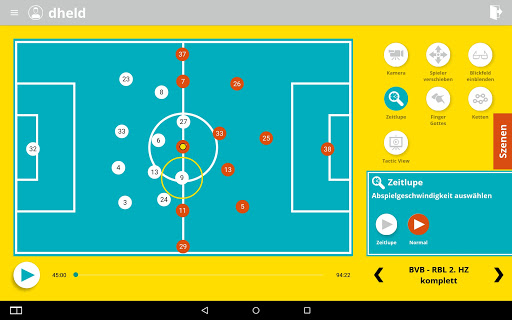
With Ralf Rangnick almost sure as the next coach of next Milan it is expected that he brings data science and modern techniques to our club which is in a huge need of an upgrade
TRANSFERS
Before Klopp’s arrival Liverpool’s transfers was a mess. They sold Luis Suarez to Barcelona for 81 Million to Barcelona and never replaced him. They invested in players such as controversial striker Mario Balotelli, misfiring Christian Benteke, Benifica’s Lazar Markovic. Even under Kenny Dalglish Liverpool made a few busts in the form of Andy Carroll, Stewart Downing and Charlie Adams. With Jurgen Klopp at the Helm and Ian Graham supplying him with mountains of data he collected of over 100,000 players it was easier for them to sign players and Jurgen Klopp has hardly put a foot wrong. Mane, Robertson, Van Djik, Salah have all been crucial parts of the Liverpool team’s success in the last 2 years.
It is no co-incidence that majority of Klopp’s and Liverpools purchases are players developed under the watch of Rangnick. Sadio Mane, Firminho, Naby Keita are all players that have been trained under Gegenpress in Red Bull teams or Hoffenheim. With Milan spending nearly 500M in the last 3 seasons and yet struggling to make it out of the rut they seem to be in, it is the need of the hour that somebody who knows business steps in to make more smarter purchases.
FINANCES
While is it difficult for Milan to emulate Liverpool financially given the marketability and massive TV deal of the English Premier League there are a few pointers Milan can take from Liverpool. One of the main sources of revenue for a club is match day ticket sales and Liverpool under the FSG ownership own 100% rights of Anfield. In the year 2018-19 Liverpool made 91 Million euros from stadium alone. And without rent to be paid to the municipality 91 million represents a pure profit for the club. This is against the 34 million made by Milan in the same period. And since Milan don’t own the stadium they pay 15M rent to the Milan municipality (doesn’t include maintenance costs which are extra) has proved to be a financial burden for the club. Perhaps this explains clearly as to why both Milan clubs want to move out of San Siro with an agreement with the municipality ready.
Liverpool bought Filipe Coutinho for 13M in 2013 and he was a central part of Liverpool’s title push in the 2013/14 season. Later he became an integral part of Liverpool around which Klopp built his team around him. Later in 2017 summer Barcelona saw Coutinho as a replacement for their legend Andres Iniesta. In 2018, Coutinho departed Liverpoool to Barcelona for a fee of 145M. it represented a capital gain of 132M and it helped liveprpool reinvest without being affected by Financial fair Play. Milan on the other hand have only made 55M profit in the last 5 years from player sales. Player sales represent quick way of making gains for clubs and selling players is something Milan should learn to do in an era where Milan are no longer under the financial might of patron Berlusconi and financial fair play of UEFA.

CONCLUSION
In a bid to recreate the Liverpool model Milan engaged in month long negotiations with Ralf Rangnick and seem to have finally got their man. But to revive a fallen giant is no easy task but an expert at rebuilding sides Ralf would relish the challenge of excelling in the very club his mentor and inspiration Arrigo Sacchi did. Klopp has shown the way how intelligent investment combined with good man management can reap rewards. What worked for Klopp was how the Liverpool board placed their faith in him and did not sack him the moment things seem to go bad. A genius like Rangnick deserves the same patience at Milan too.
 The Milan Blog