
INTRODUCTION
If there was any team that represented Italian football and took it to heights never seen before, it would be none other than our beloved club A.C.Milan. If anything Milan was the first team to bring the European honors home and set of a tactical revolution in the form of Catenaccio that set of Italian football’s success in the 60’s with the Grande Inter side and Nereo Rocco’s Milan.
However Catenaccio had run its course and Italian football was waning. Milan had undergone a takeover from media moghul Silvio Berlusconi and he wanted to bring success to the red and black of Milan.
After losing to a small Parma side over 2 legs in the cup, Berlusconi appointed Arrigo Sacchi as the coach of Milan. It shocked everyone in the press as Sacchi had no great prior experience as a player or a coach to which he retorted “I never knew to be a jockey you needed to be a horse”
Sacchi was hugely influenced by Rinus Michel’s and Johan Cryuff’s passing football as well as the great Brazilian teams over the years. He wanted his teams not just to win but to entertain the fans which was against the grain of Italian football in the 80’s which was immersed in Helenio Herrera’s idea of defensive Catenaccio.
In this article, we have a comprehensive look at the tactics and training methods of “prophet of fusignano” with which he won 1 Serie A, 2 European Cups and 2 Intercontinental trophies.
Even today his theories and his ideologies have application in the form of Klopp, Rangnick, Flick and Nagglesman.
TACTICAL ANALYSIS
As mentioned earlier, Italian football was rife with Catenaccio whose powers were slowly waning as coaches from other parts of Europe had found the solution to break the notorious tactic.
Catenaccio was a system that used heavy man-to-man marking and full back came into the back therefore out-numbering the opposition team’s attackers. And there would be a spare defender called a Sweeper or Libero. Milan had the famous Cesare Madlini play as the sweeper and for Inter it was Armando Picchi. The formation for Catenaccio was 1-3-3-3 or a 1-4-3-2. The team would man mark the player win the ball back and counter attack quickly which usually depended on an intelligent #10 such as Italian Golden boy Gianni Rivera.

Sacchi came to management with a totally different perspective. Having been influenced by Rinus Michels, Ernst Happel and Brazilian football he wanted to bring a chance. In 1987 when he was appointed the coach of Milan he brought in Ancelotti from Roma, Ruud Gullit from PSV and Van Basten from Ajax. To understand his style of play it can be broken down into facets.
Formation
Under Sacchi Milan preffered a 4-4-2 system which was until then very rare in Serie A. If Catenaccio was all about man-marking, Sacchi’s system was all about Zonal marking where players are asked to mark a particular zone rather than a player. This is done to squeeze the space between the lines and win the ball back as quickly as possible. With this system the role of a Libero was eliminated and Baresi was seen more as a pro-active defender snuffing out attacks before they became dangerous.
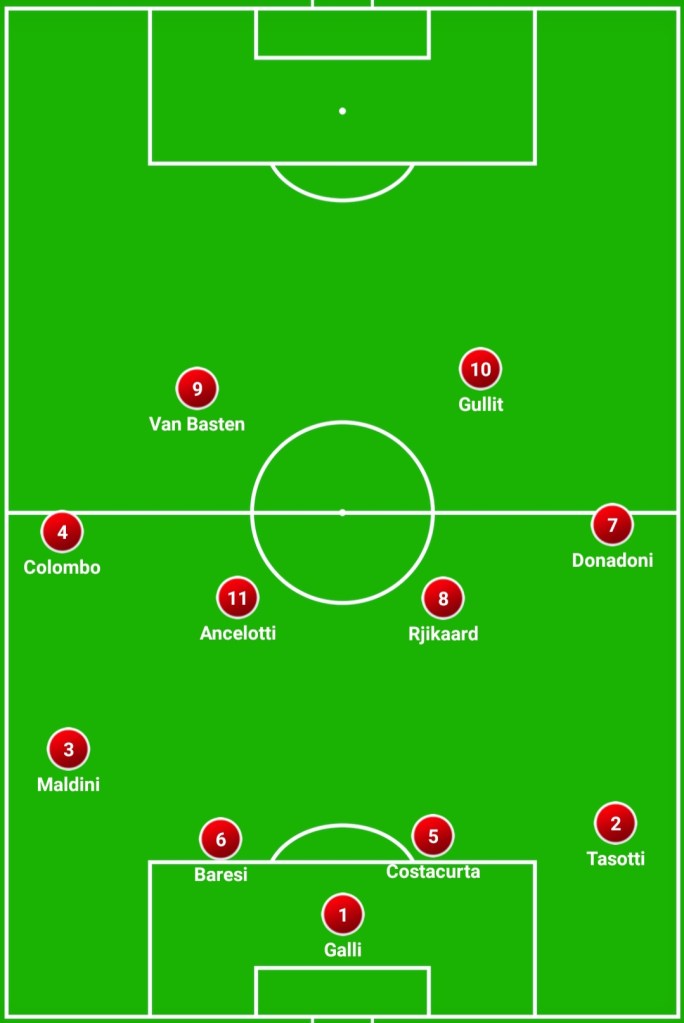
Pressing and Compactness
With Milan preferring to use zonal marking than man-marking it was essential that they learn how to defend using cover shadows or as it is now called cutting out passing lanes for the player in possession. When Sacchi had his charges trained in shadow play in the training field it was to teach these players to press structurally as a team by cutting off passing channels and make the player in possession make a mistake and give possession away.

One of the initiators of this press was Carlo Ancelotti who Sacchi described as not the most physically exhilarating but played football in his head. Ancelotti often initiated the press when the ball was in midfield and with a few tactical tweaks it benefited Milan. Ancelotti would leave his position and press the player in possession and baresi would often step out of possession to aid Ancelotti’s movements.
To keep the defensive shape of the team and to initiate quick counters Sacchi demanded high workrate from his widemen in Donadoni and Colombo.
One of the most important factors to play this press while maintain a high line was that the team had to be compact on the pitch. There was not supposed to be not more than 15-20 metres between the 3 lines of players.

However Milan were having issues to adapt to Sacchi’s ideas as it was a relatively new concept in Italian football and with Ancelotti in midfield he was sometimes getting outnumbered or even was getting bypassed. Milan was knocked out of European Cup by Espanyol
The signing of Frank Rjikaard
The now famous moniker 3 dutchmenwas completed when Milan signed Frank Rjikaard in the summer of 1988. Frank Rjikaard was the physical presence Milan Sacchi missed to comlete his side.
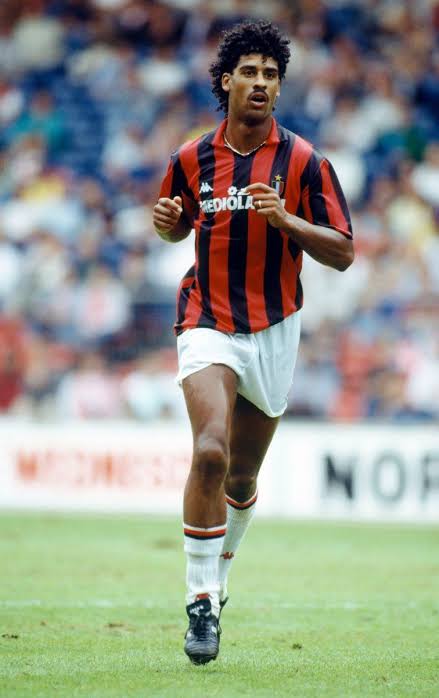
Rjikaard acted as a cover to Ancelotti. He could win tackles, press with high intensity, act as a shield to the back 4 and even make runs and act as a third man in the front. His signing reduced defensive burden of Ancelotti and he was free to pick defenses with his passes. This also meant that Baresi did not have to step out of the defence to help Ancelotti and there for closes any gaps present in defence
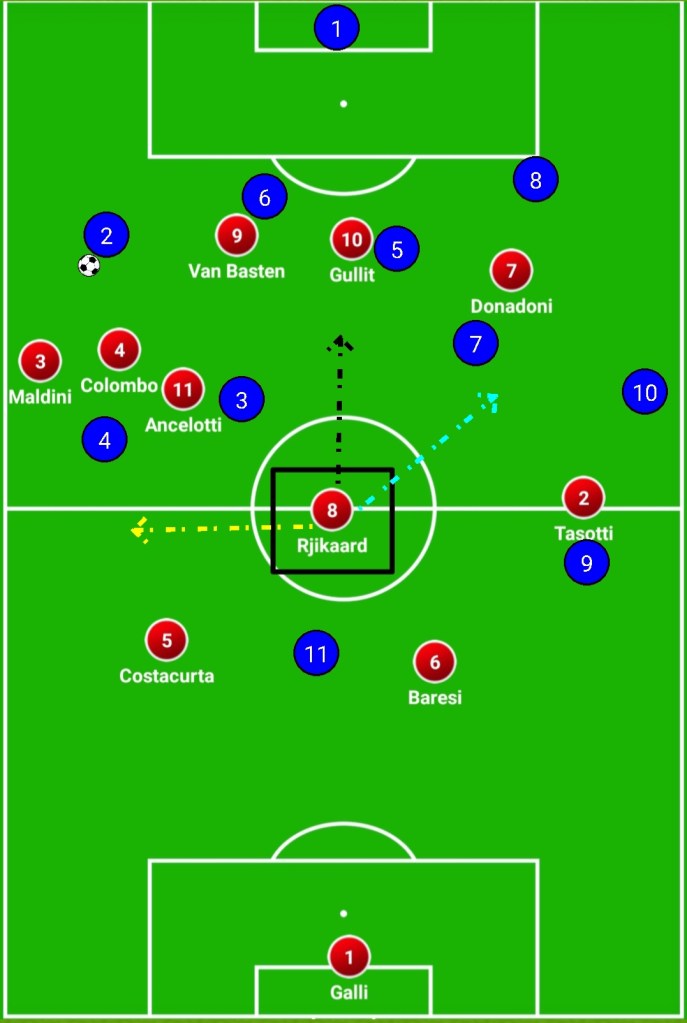
The signing of Rjikaard also gave Milan the ability to press horizontally and press the wide-players or wingers using the touchline as an extra man. Rjikaard would cover the space left by Ancelotti to press the wideman. Van Basten and Gullit would cover a back pass and Donadoni would prevent a switch of flanks.
The Offside Trap
Another weapon in Sacchi’s arsenal was the offside trap. To prevent teams from advancing Sacchi took advantage off the offside rules prevalent in those times. Milan’s last line of defense as a whole would advance forward catching the opposition offside. Now this is a risky tactic as it needed a lot of co-ordination between the players in the last line of defense because even if it is not executed perfectly the opposition strikers are put clean through on goal.

Attacking phase
As Sacchi wanted his teams to play good as well as entertaining football he had his teams score goals galore.
Initially in the 1987-88 season Carlo Ancelotti was the one who initiated the build-up play once Milan regained possession of the ball.
Ruud Gullit was the vital cog in Milan’s attacks acting as the linkup between attack and defense. Once Milan won the ball they would find him with a vertical pass. He would drop into space or between the lines no matters how compact the opposition defense was and teammates did not have a problem in finding him. Such was the quality of the player.
Once Milan signed Frank Rjikaard it freed Carlo Ancelotti from defensive duties. Carlo would move further left from the centre while Maldini pushed up as an advancing full back to become a passing option while Colombo and Donadoni would keep moving infield into the half spaces while width was mostly provided by Donadoni or Maldini

Milan barely wasted time on the ball. They always tried to make their attack productive rather than play unproductive passes. With Carlo Ancelotti carrying out attacks Milan would play quick one-touch vertical passes often forming passing various passing combinations and passing triangles. Width and crosses was provided by Maldini or by Donadoni.

Overtime with developing team chemistry and fluid play Milan became unplayable and whenever Van Basten was Injury free he would pierce opposition defenders with his deep runs or make space for team-mates with off the ball runs.
TRAINING METHODS
What Sacchi was attempting was a total revolution in the way players understood football. He, therefore needed to design training methods which were unique and fester fluidity and understanding. One such method was shadow play where players trained without a football. Sacchi would tell which position the ball was and players would align themselves as per the movement required to press or pass as per the movement practice.
Another method was to play with a numerical disadvantage which would make the players train extra hard. The best part of it all was that the players were extremely intelligent and physically able as well as willing learners who practiced the movements to perfection
CONCLUSION
When Bayern pipped PSG to win the UEFA Champions League 2020, you could see Bayern applying various concepts that Sacchi immortalized through his Milan towards the end of the 80’s and beginning of 90’s. With Sports medicine and training facilities not as advanced as modern day equipments, his physically demanding style of football took its toll on the players.
Sacchi left A.C.Milan for the Italian national team in 1991 and almost replicated the success of Milan with Italian National team in the 94 world cup only to be denied with Roberto Baggio missing his penalty. Sacchi did come back to coaching Milan in to coach for Milan 6 months in 1997 but he could replicate his earlier success with the club. This followed a stint in Atletico Madrid where he was unsuccessful. But Sacchi had already written his legend in the annals of football and modern managers such as Klopp, Flick, Nagglesman, Tuchel can be seen using his ideology to win matches
 The Milan Blog