
After being winless in 4 games, the tension within Milan and its fan base was palpable. The losses to Spezia and Inter hung on people’s minds as Milan travelled to the Olympico, a place where Milan have only won 1 out of 6 games and are the only team not to lose at home this season in Serie A.
TEAMS AND FORMATIONS
The Big news for Milan was that after a huge out roar on social media captain Alessio Romagnoli was dropped for Englishman Fikayo Tomori. They lined up in the usual 4-2-3-1.
Roma meanwhile lost their talismanic striker Edin Dzeko to injury. Fonseca stuck with his strong 3-4-2-1 with Borja Mayoral playing as the #9. Roma also missed Smalling, Ibanez, Zaniolo and Kumbulla.
ROMA’S TRANSITION AND PRESSING
After the last few games it’s pretty clear that Milan’s kryptonite is that they failed to build out from the back if the opposition press their double pivot and cover their passing lanes.
Roma pressed in a 5-2-3 formation off the ball. They packed the center of the pitch, cut off passing lanes to Tonali and Kessie and forced Milan to go wide. When Milan play wide they use their wingbacks to press our fullbacks

In order to maintain the high press, Roma maintained a very compact shape not keeping more than 15-20 metres between their first and last line. This high line tactic was a risk-reward approach.

In terms of chance creation Roma, often had one of their forwards drop deep and use one of the double pivot to form passing triangles with a Center back bringing the ball out from the back to break out of Milan’s rather good press. Once Roma have progressed into Milan’s half they use overlapping runs from their wingbacks, mainly Spinnazola and later Bruno Perez to hit on Milan’s narrow 4-4-2 formation off the ball.
MILAN- CHANCE CREATION, HIGH LINE AND SWITCHES OF PLAY
What has improved in this game has been Milan’s urgency, their pressing intensity and lightening quick counters. And the biggest sigh of relief was how Milan were able to execute passing combinations and create chances. The score line does not suggest how Milan were good in creating chances.
One of the main chance creations techniques was to take advantage of Roma’s high line. Once Milan won the ball back by pressing Vilar or Mkhitariyan they would try and spring balls in behind the defense of Roma for Ibrahimovic or Rebic.

Another tactic to break out of Roma’s press was to suck Roma into a particular wing and use Kjaer or Kessie to switch play into the opposite wing. Quite often Milan would even use Calabria or Saelemaekers to carry out the deed.
A very important factor I would like to talk about how Milan were able to maintain a very high line, as high as some of the Premier League teams do, thanks to the pace of Milan’s backline. Adding Tomori to the backline helped Milan in multiple ways. For once it helped Milan to free Kjaer and Kessie to push and press Roma’s midfield pivot. Tomori would sweep up behind Theo, Kessi and Kjaer hence even though Roma tried to target Milan’s high line nothing came out of it. The Recovery pace shown by Fikayo Tomori has shown fans how even if you get beaten high up on the pitch you can make it back to your defensive positions.
SUBSTITUTIONS AND MILANS CHANGE IN FORMATION
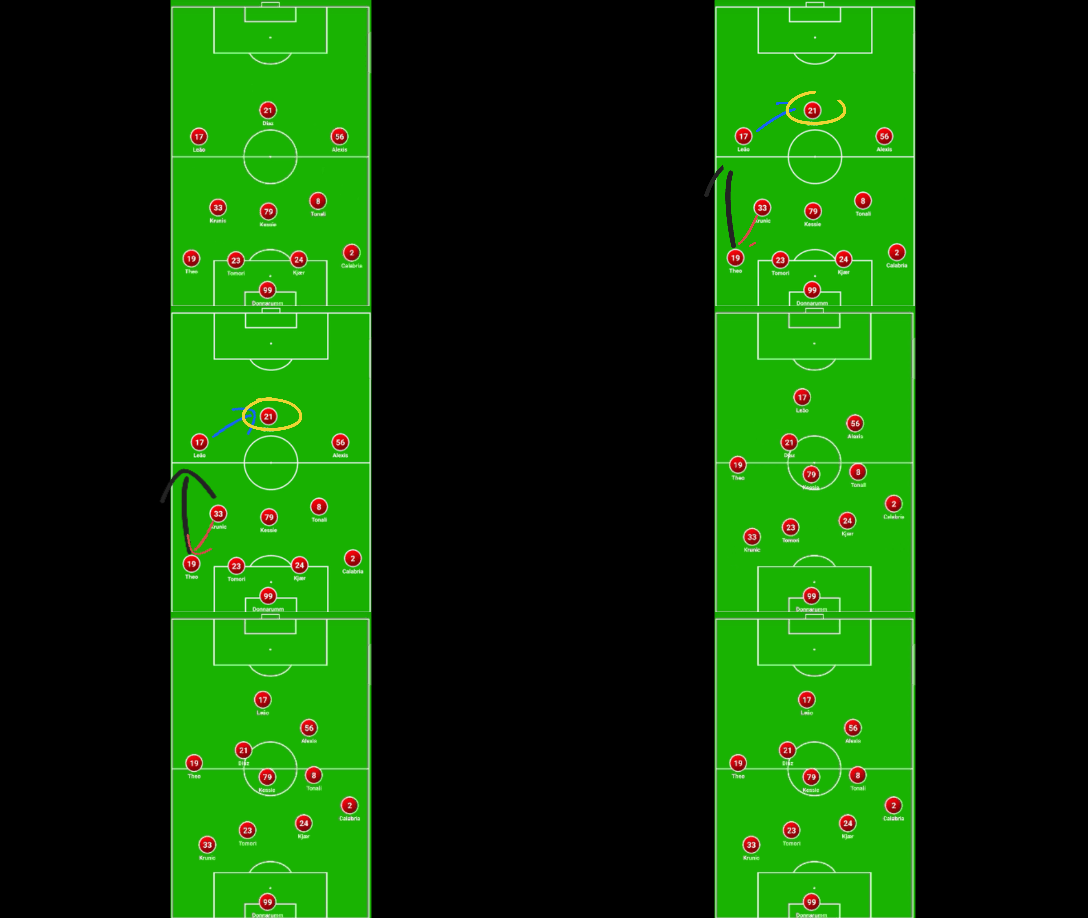
A rather confusing substitution for Milan fans was how Pioli brought in Krunic for Rebic instead of Hauge. This was because Pioli wanted to change the formation to the conventional 4-3-3 with no recognized striker.
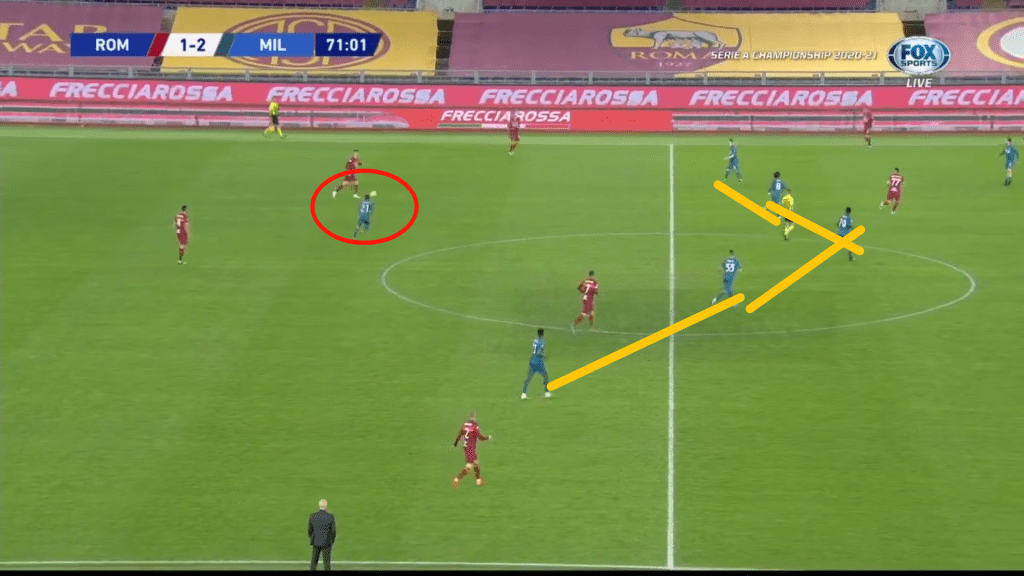
Diaz acted as a false 9 giving Leao the space to drift in from the left wing. Krunic prevented any counter attacks Roma had planned on Milan’s left hand side incase theo lost the ball and Roma sprung the counter with Bruno Perez
 The Milan Blog