
They say life comes a full circle and on 23rd of May 2021, a 360 degree turn that began on 22nd December 2019 with a 5-0 drubbing at Bergamo ended with a 2-0 win at Bergamo taking Milan to the Champions League after 7 long years of waiting.
A season that was filled with its ups and downs, Milan fans experienced the roller-coaster of emotions. From the 25 penalty shootout on a rainy night in Portugal to defeating derby rivals Inter, going on an unbeaten 28 game run to almost throwing the bare minimum of Champions League qualification before reviving hopes with the 10-0 win over the Turin clubs this season would have easily got an Imdb 8/10 rating if it was a Netflix series.
But for any champions who wishes to prove that success is no accident, it is always essential that a review of their actions are taken to rectify errors and replicate the correct decisions. For Milan, a fallen giant it is of paramount importance that they scrutinize every avenue related to the club because the margin for error is very small.
With the failed project of the Super League highlighting the disparity of income between the cash-rich English Premier League and Italian Serie A, Milan needed to be careful with their strategy to ensure that they do not fall into financial obscurity. And entwined in a club’s finances are its transfer decisions.
With this review we intend to examine what Milan have done well in the 2020/21 season and what we got wrong in terms of the clubs finances and transfer decisions
WHAT WE GOT RIGHT
A Balanced Market
Milan were under scrutiny from UEFA under FFP regulations and hence had to balance their exits and entries. As per Transfermarkt, Milan made a total purchase of 30.73 Million and sold players worth 47.95M making it a positive net spend of 17.22M. And this came with Milan not suffering with their on-field performances and finished with their highest point tally since 2011/12 season. A job well done indeed by everyone in the management.
Trimming the wage Bill
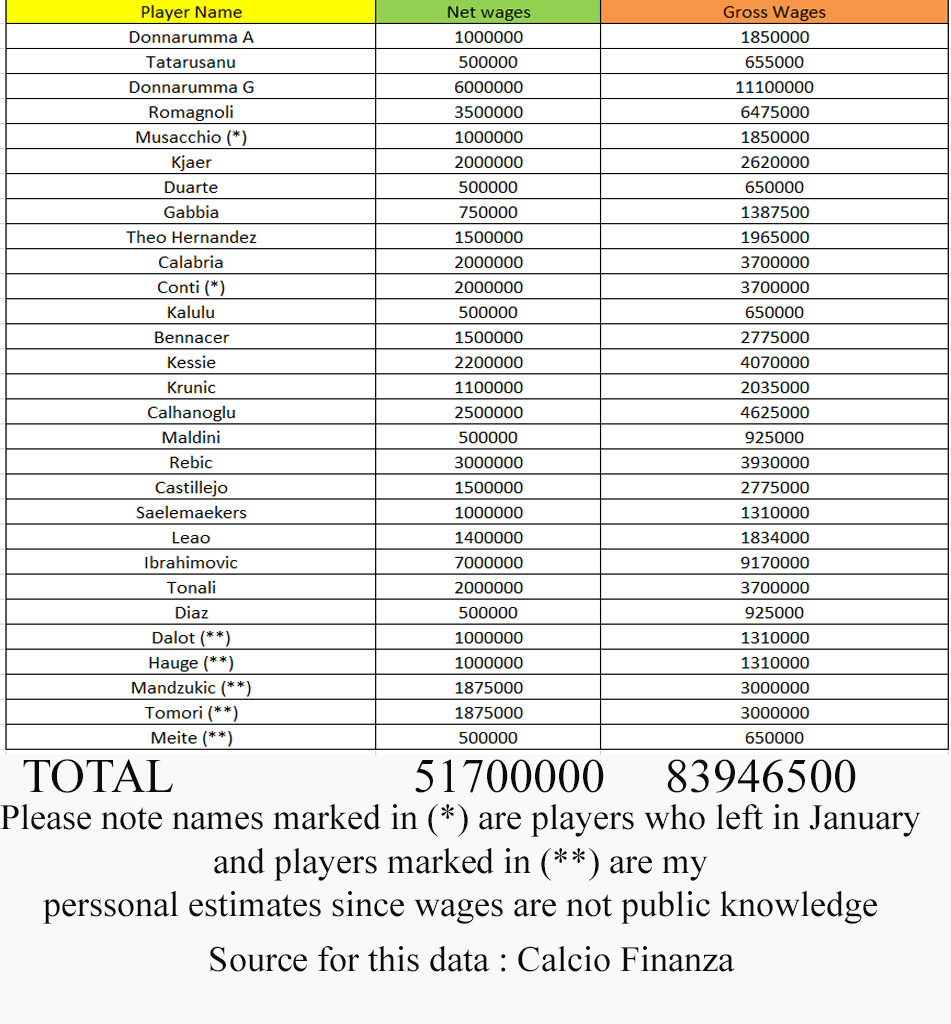
One of the problems plaguing Milan was that we Milan’s wage to turnover ratio was an undesirable number which meant that the wages were at an unhealthy high and despite high wages Milan were not achieving desired heights and therefore the exercise of trimming the wage bill started since the 2019/20 season. Bonaventura (2M net), Biglia (3M net), Suso (3.5M net), Musacchio (2M), Pepe Reina (3M net), Rodriguez (2.2M) were offloaded and players like Conti (2.2M) were loaned partially offsetting their wages. This reduced Milan’s wage bill to a total of €83.94M
The Loan signing of Tomori
The center-back duo of Romagnoli-Kjaer were strong and Milan were coasting. A failed attempt by Milan to land Simakan in the summer and winter window for a strong 3rd Center Back meant Milan had to turn to a different option. Milan decided to turn their attention to Fikayo Tomori, Cobham’s very own youth product, overlooked by then manager Frank Lampard. Milan took him on a loan after a protracted negotiations and had an option inserted into his contract for 28 Million. Tomori came on as substitute for Kjaer in a Milan Derby and impressed so much that with Alessio’s horror showing against Inter suffering at the hands of an in-form Lukaku, Tomori was preferred Alessio and at the end of the season Milan finished with 5 clean sheets with 2 of them coming against Juventus and Atalanta. Tomori finished the Serie A season with no Yellow cards, and even scored a very crucial goal against Juvenuts in the 3-0 win.
Depth signings with Loans
Milan’s main problem going into the 2020/21 seasons was how thin they were on the roster especially in midfield. And without a Manchester city-esque budget Maldini and co needed to bring in quality signings especially Biglia and Bona leaving on Bosman transfers. In-came Milan with the signings of Brahim Diaz, Diogo Dalot, Sandro Tonali and Soualiho Meite (winter signing) which ensured depth (albeit not with world class quality) but without significant spending. Diaz especially came on for Milan towards the end of the season when Milan were in a tight spot using his low-center of gravity, quick feet and work-rate. Dalot acted as a great cover for both full backs while Meite and Tonali backed up the double-pivot.
Prize money
And of course, saving the best for the last, Milan get an injection of cash with their foray into Europe’s Premier Competition. This added to the uniform TV revenue share, historical club share ranking share and position based extra.
Add this to the 15-20M Milan are set to receive from Europa Group League qualification after it took Milan a 25 penalty shootout to advance into the Europa League Group stages eventually getting knocked out in the Round of 16. Maybe with small sections of fans allowed into the stadium next season Milan have more money into the coffers
WHAT MILAN DIDN’T GET RIGHT
The Striker situation
Milan made quite a splash when they signed Ibrahimovic in 2020 January who was 38 years old at the time but his impact on the team was unfathomable and eventually raised the level of players around him. In the summer Milan had a delicate situation on their hands, they knew that Ibra at 39 was no longer the physical force he once was and therefore an able backup who could play 20-25 games in a season was required but the management put undue faith into Rafael Leao and Rebic to slot in the no.9 role when both of them were more comfortable playing off a striker and dint have the kind of hold up play Zlatan offered. Eventually Zlatan ended up missing 20 games of the 38 in the season and Milan were scrambling to plug holes in the gap
The Mandzukic transfer
To ease the burden off of Zlatan Milan went the bosman route taking Mario Mandzukic on a free after he left Al-Duhail. But the transfer turned out to be a disaster. Mandzukic ended up missing more games than Zlatan in that time period as his injury issues were never-ending and it were as if Milan never had a no.9 to play off of. The January mercato was a very strange one not just for Milan but for Europe thanks to a pandemic affected Economy with only 1 or 2 transfers breaching the 20 Million mark. It is understandable that Milan couldn’t invest but somehow Mandzukic didn’t just work out.
Ignoring the Right Winger situation
Another area that needed Milan to invest was the Right-Wing. Everybody knew that Samu Castillejo and Alexis Saelemaekers wasn’t the explosive creative soul that Milan wanted with Castillejo having one of his worst seasons in his Milan career. While Saelemaekers helped to keep the system functional it was evident against teams who played a low block that Milan needed a creative outlet just like they had on the left. We can blame this on the pandemic affected economy but it was a gaping hole that needed to be filled.
Not finding a solution for Krunic
“A square peg in a round hole” is the most apt description for Krunic. He was a misfit who came on whenever Pioli wanted to close down games. Don’t get me wrong, Krunic bled for the shirt. He covered the most ground whenever he played a full game, never complained whatever role he was given but somehow it makes one wonder whether Krunic is an opportunity missed to raise some cash and have it re-invested for a player that could suit the system.
CONCLUSION
Various sources have reported that Milan are set to close the 2020/21 season with a loss of 95 Million, 100 Million less than what they did from last season. Commercially the good times are about to begin. More Prize money, more sponsors and with exciting projects like Milan Studious and collaboration with RocNation, EA Sports, BMW shows the Milan brand is growing.
Gazidis in his interview to CorSport mentioned the 2021 Summer will be different from the previous ones and Milan have already shown their intentions by signing Mike Maignan and are in advanced negotiations for Diaz, Tonali and Tomori.
For the next edition we will review Milan’s on-field performances and tactics.
 The Milan Blog