Let us explore some of the tactics behind the goals of the much anticipated Verona-Milan game.
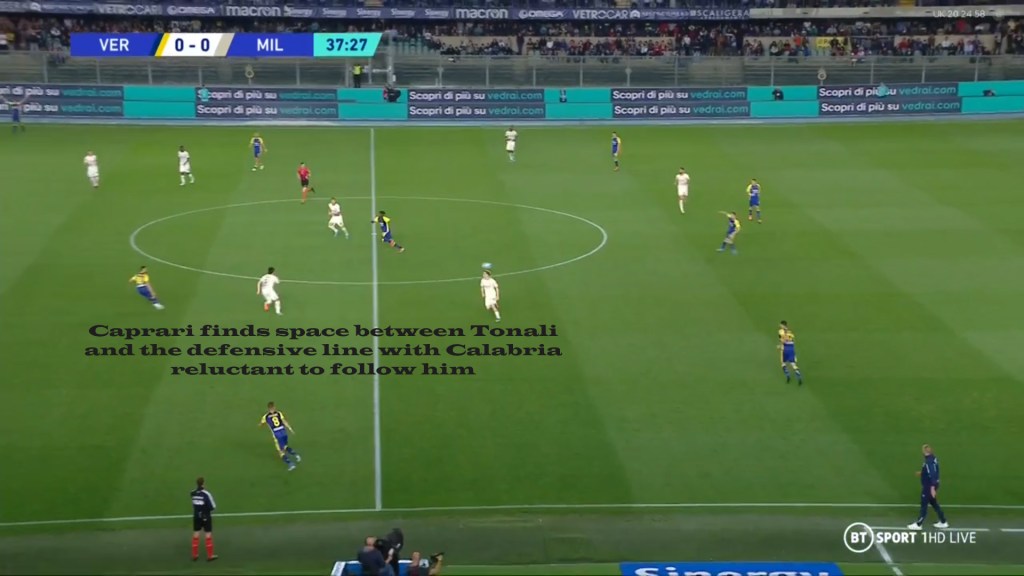
Fatale Verona was something which was on the minds of Milan players when they came to the Bentegodi and history looked to have repeated itself when Verona took the lead in the 38th minute despite Milan dominating the match for a good part of the game
Verona play with two #10’s in their system. This allows them to find the space between the midfield and the defense. Caprari on this fatal occasion found space between the lines with Calabria reluctant to follow his marker.
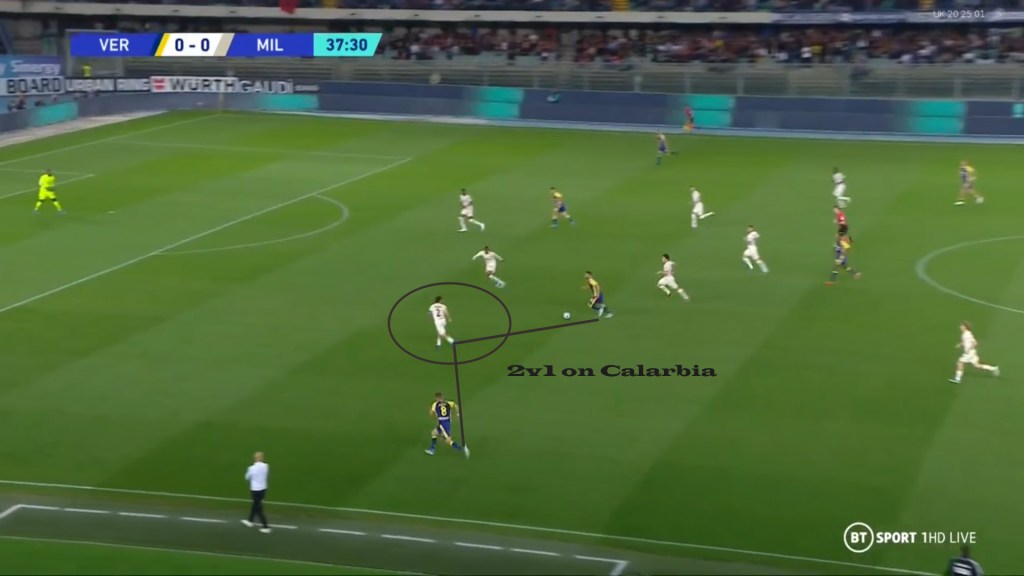
This put him in a grave situation with Lazovic overlapping and creating a 2v1 on Calabria and the defender tried to call the bluff of Caprari and didn’t follow Lazovic. Kalulu tried to help Calabria out but by then it was too late.
Milan’s first goal came courtesy of a press by Kalulu, a forced error from Caprari. This helped Tomori to capitalize on the unorganized defense of Verona and slide a pass through to put Leao on a 1v1 with Gunther. You can already see Tudor screaming at his players to quickly get back into their positions
Faraoni could not help Gunther double team Leao and he wreaked havoc
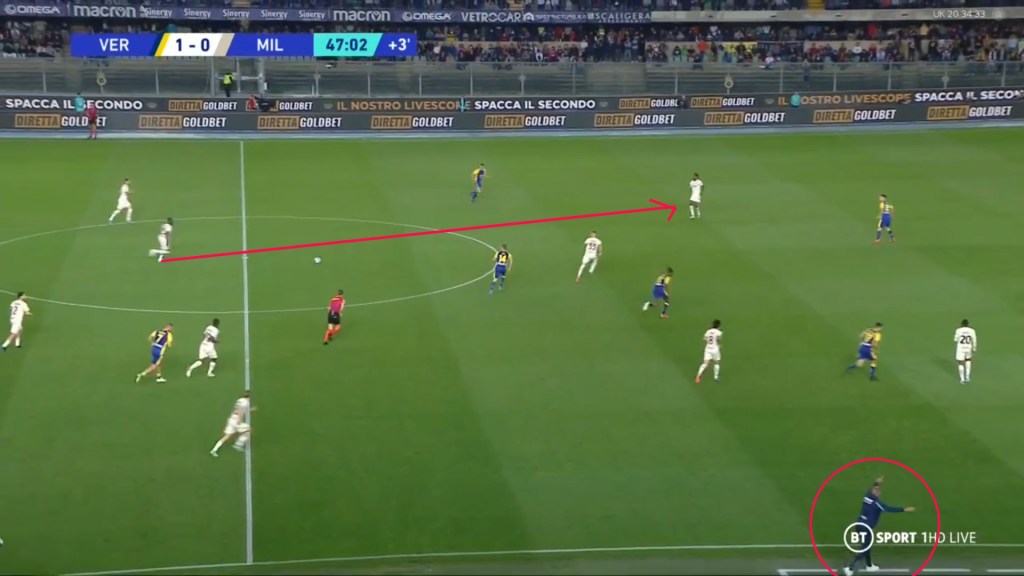
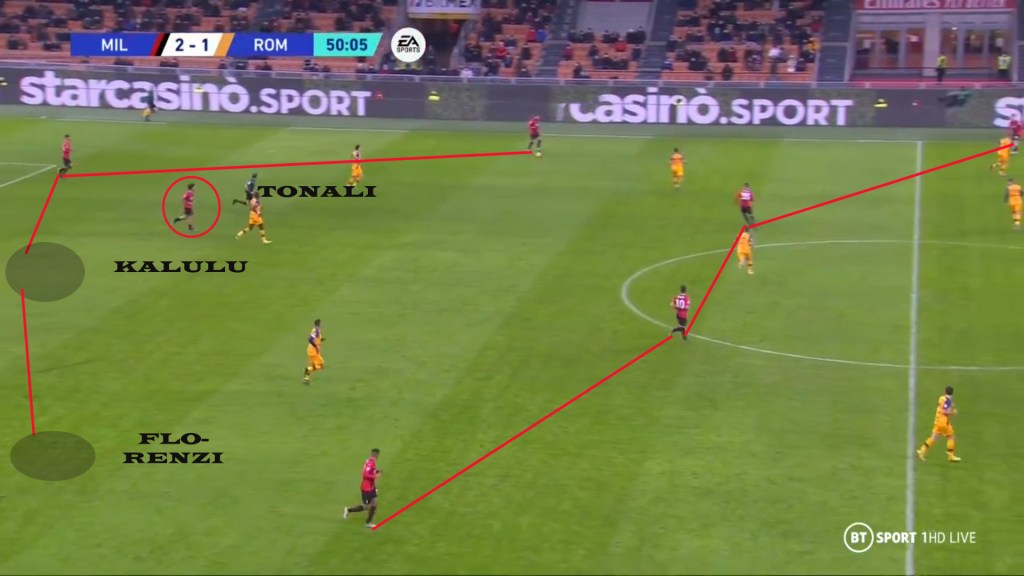
For Milan’s 3rd goal a successful switch helped Florenzi find space on the right side.
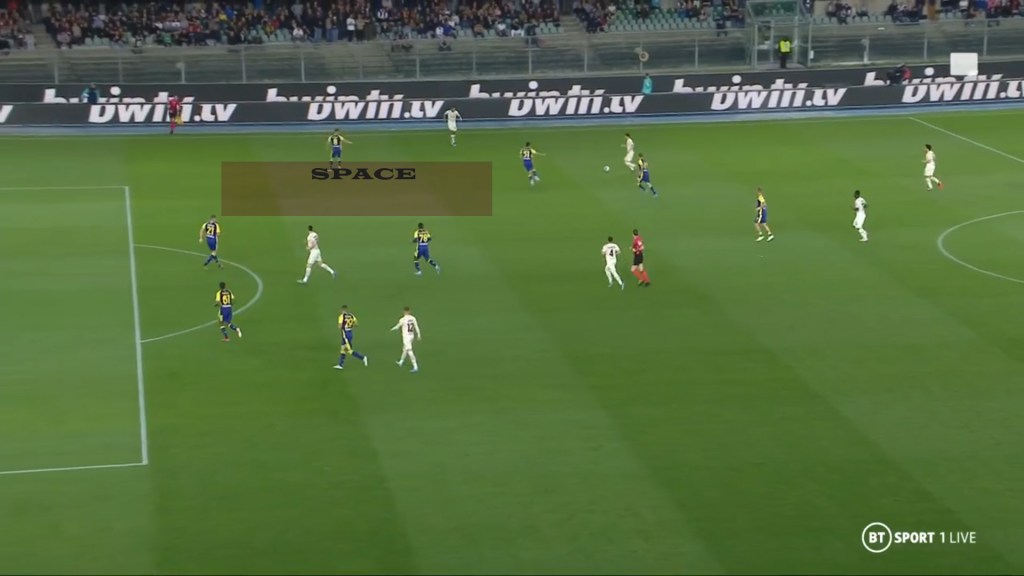
With the midfield of Verona stretched it forced the Center Back, Sutalo to come out to challenge Florenzi essentially creating a 2v2 (messias being covered by Lazovic). However since Sutalo left space behind him, the quick one touch passing from Florenzi opened up the space and Florenzi whipped out a brilliant shot to score.
The average positional map pot game seems to suggest Milan played more of a 4-3-3. In this game Kessie sat back as the Defensive midfielder (#6) while Tonali pushed up as the (#8). Maybe a formation change next season ?
Milan and Bologna came to a draw on Monday to frustrate a packed San Siro crowd. Here are some of the tactical points
BOLOGNA’S 3-5-2
Bologna clearly knew Milan’s weakness has been in the center and therefore they opted to play a 3-5-2. One of the main strengths of a 3-5-2 is their ability to crowd out the center and have an extra man in defense.
A significant feature of a 3-5-2 is that when played deep and closer to one’s own goal it becomes increasingly difficult for the oppodition.
3-5-2 needs a lot of counter attacks and runs from the midfielders to complete it’s attacking side and this could be seen in the earlier part of the first half. But the most important part was the partnership between the front 2. Arnautovic and Musa Barrow were able to hold the ball up, do interplay and give respite to their defenders who had to keep Milan’s forwards at bay.
WHAT MILAN COULD HAVE DONE TO BREAK THE DEEP BLOCK
A deep block is extremely difficult for both sides. For the defenders they would have to keep their concentration the entire time the ball is with the opposition and for the attacking team to find space between the lines.
This would maybe explain as to why Pioli kept on Diaz instead of subbing him because as a #10 it is his primary function to find space.
Since parking the bus involved playing a deep compact block, Milan didnt attempt to do quick passes and positional changes near the wide areas to either set a FB free to cross or to have space to breach the block and get inside the box
Very few attempts were made by Milan’s #9 Giroud to get to the near post to recieve a cross. One such attempt was when he chested it down to Calabria.
Another method to break a deep block is to have your full back run to the far post just like Hakimi has made one here.
Calabria did make it to the far post but he missed his chance. The same was however not tried for Theo, probably due to the fear of getting countered on the wings through Hickey.
To understand this one needs to delve into the situation Pioli arrived in Milan at. When Giampaolo was sacked and Pioli was appointed as the coach of Milan he joined a team that was vastly an unknown quantity not just to him but among themselves. So he stuck with the formation used by the previous coaches, the 4-3-3 formation. However as we all know it all culminated with the rout at Bergamo with Atalanta trashing Milan 5-0 and a huge out cry for tactical changes being called for.
Before the match at Bergamo a few points became amply clear to Pioli
Theo Hernandez has enormous potential to play as a pseudo left winger and can even score goals (was Milan’s top scorer until Februaruy)
Kessie is best utilized as a Defensive midfielder who can make a few runs but he is not the best with his creativity or on the ball skills.
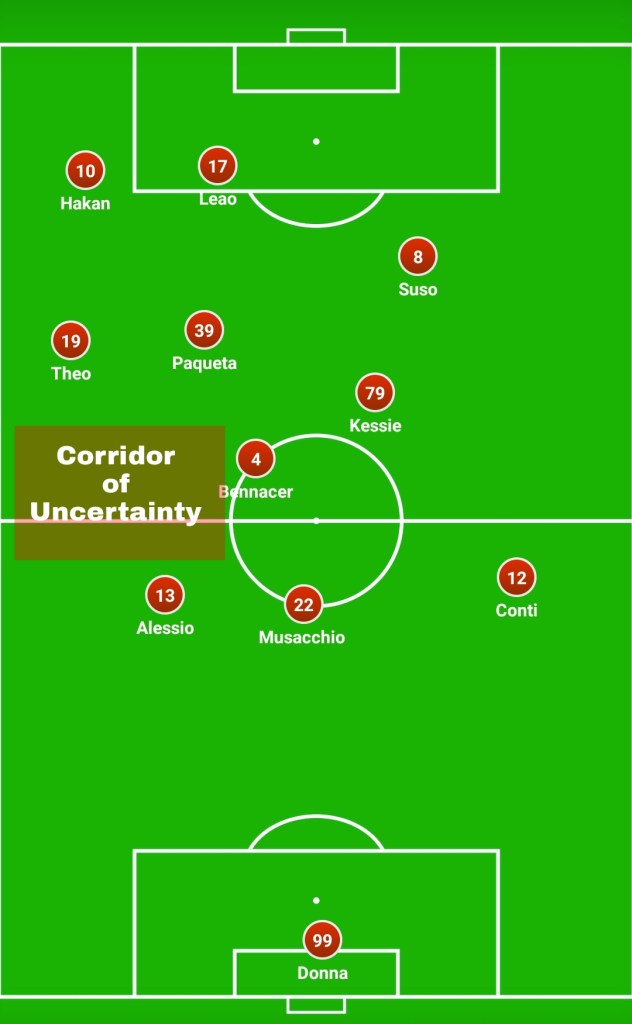
Romagnoli is not the best defender when dealing with pacy wingers or strikers and with midfielders expected to make runs to support the forwards in a 4-3-3 and with attacking it creates a “corridor of uncertainty” on the left
Bennacer is not an apt player to play as a holding midfielder in a single pivot.
These factors and the 5-0 defeat played on Pioli’s mind and it made him want to change the formation to make sure he keeps up the pressing but also provide help for the attackers in the wide area
After analyzing Flick’s Bayern, Pioli decided to switch to a 4-2-3-1 and this utilized his team’s strength the best by
With a double pivot it gave extra security to Pioli to guard against counter attacks which is one of the 4-2-3-1’s main strength.
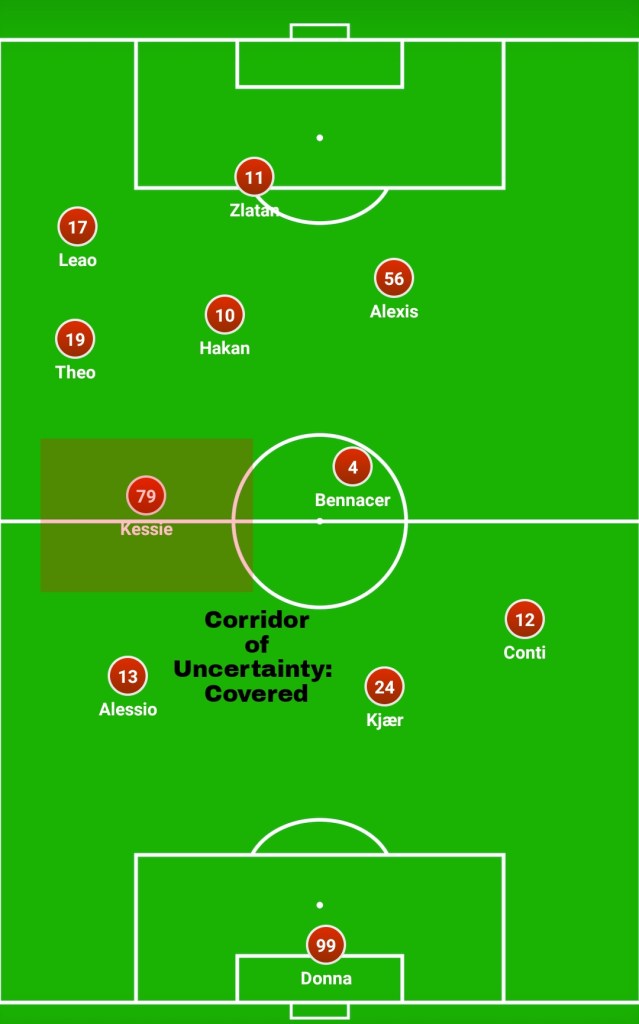
Kessie being to the role of a defensive midfielder on the left side covered the earlier mentioned corridor and it allowed the defense to keep its structure allowing Theo to sprint forward and Romagnoli an extra cover
Kessie’s change of role also helped Bennacer to have more freedom having been liberated from having to shoulder the entire responsibility of screening the defense and it helped him to make those runs into the attacking third
Theo got to join the attack and underlap/overlap the left sided winger.
And of course with Zlatan being signed he gave Pioli a striker to play off or a target man to aim crosses and even hold up play for Theo to make runs off.
Fast forward to 2021/22 season Milan are seemingly going to lose Kessie and Romagnoli on a free transfer after Milan lost Hakan as well. Milan have already secured Yacine Adli from Bordeaux who is a hybrid of a #8 and a #10.
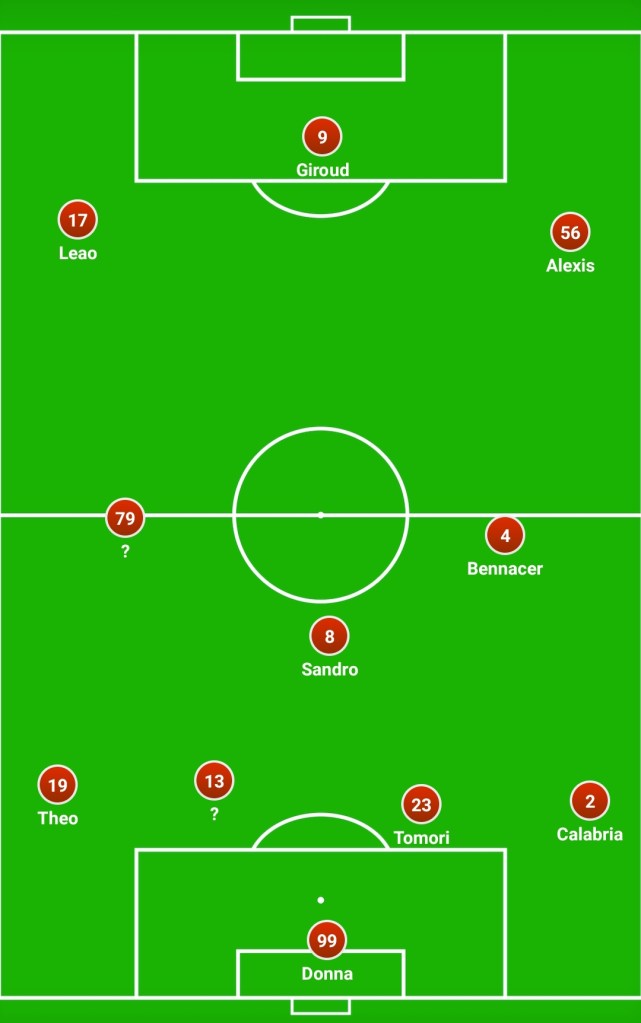
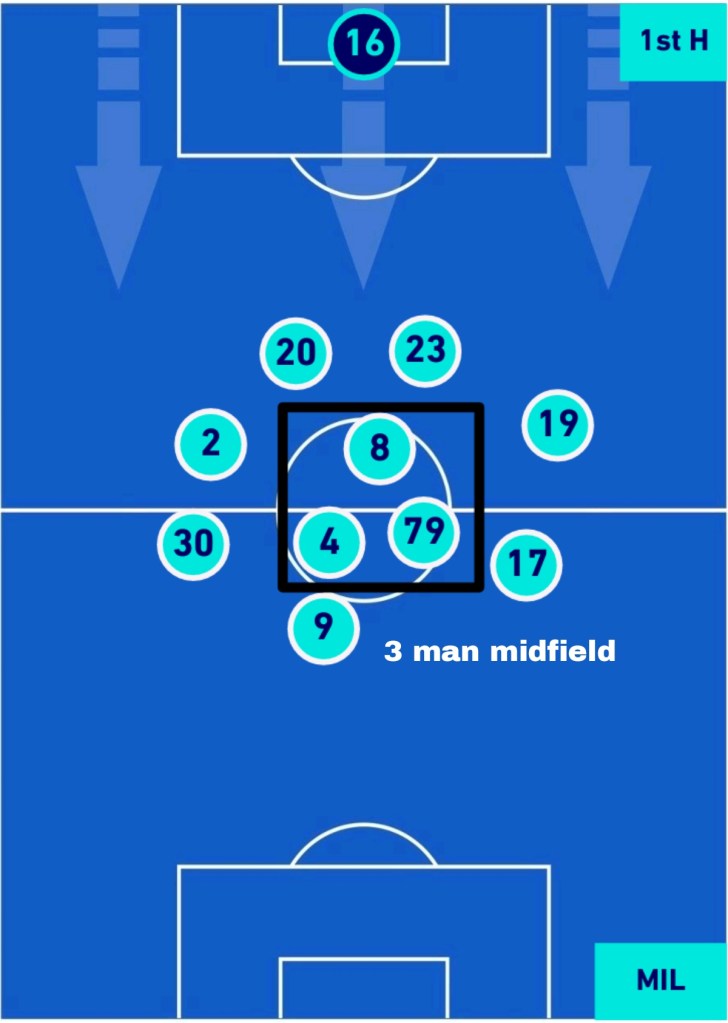
There have been talks of Milan switching to a 4-3-3 and the average positioning map against Napoli seems to suggest the same. Here is why a 4-3-3 would be a natural evolution for Milan
The 3 man midfield against Napoli
A 3 man midfield would give Milan a midfield superiority. When Milan played with a 4-2-3-1 it needed the natural #10 i.e Diaz or Hakan to sit back with the double pivot whenever they lost the ball the make sure they don’t get numerically beaten in the midfield as they seemed to be against teams that play a 3-5-2 or a 4-3-3.
It gives Milan more control in midfield and helps them play more fluid football with more options in midfield.
It takes away a chunk of responsibility of creativity and the need to connect defense from attack by the #10
With no Kessie who did not display the best of his abilities as a mezalla. If Milan can pull off the signing of Renato Sanches or another attacking midfielder then Milan will have extra midfield players who can make runs into the box and hence extra attacking options which can be difficult to defend for the opposition.
This team is into Year 3 of their project with Pioli and Maldini. They have created a good environment of trust and they know each other’s movements very well. Along with this the players and manager are in total harmony with each other. It helps for more options
With Theo more mature and selecting his moment to attack carefully and not bomb at every opportunity there is less opportunity for opposition to counter
With Romagnoli being seemingly replaced by Tomori who is one of the fastest and most aggressive center backs in Serie A once again that corridor of uncertainty is closed.
Bennacer, who like Theo has matured, has shown how he can cover lots of ground and contribute to attack with runs like the one he made against Napoli (when Kouilybaily fouled him) is also ready
With a vibrant midfielder like Tonali who also covers a lot of ground and can run at top speeds of 35 kmph can act well as a midfielder in the single pivot and single handedly screen the defense and recover lose balls when Milan play a high line
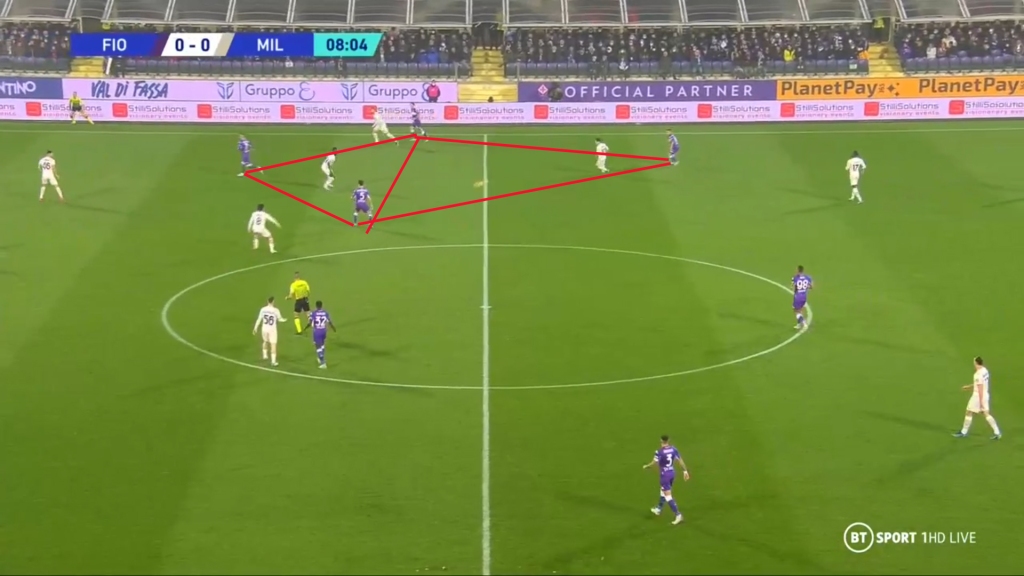
It gives Milan more passing combinations and more options to create passing triangles and/or Passing diamonds to go past opponents.
Napoli and Fiorentina creating passing Diamonds to beat Milan’s press
CONCLUSION
Of course this is only a tactical theory on a personal level and there is yet a lot of games to come this season plus an entire summer market which can dictate the game plan for next season. One thing is for sure, Pioli has given a thought to the system and Milan did try it out (albeit to neutralize Napoli’s midfield) one wonders if signings like Renato Sanches and Adli signals a change of things.
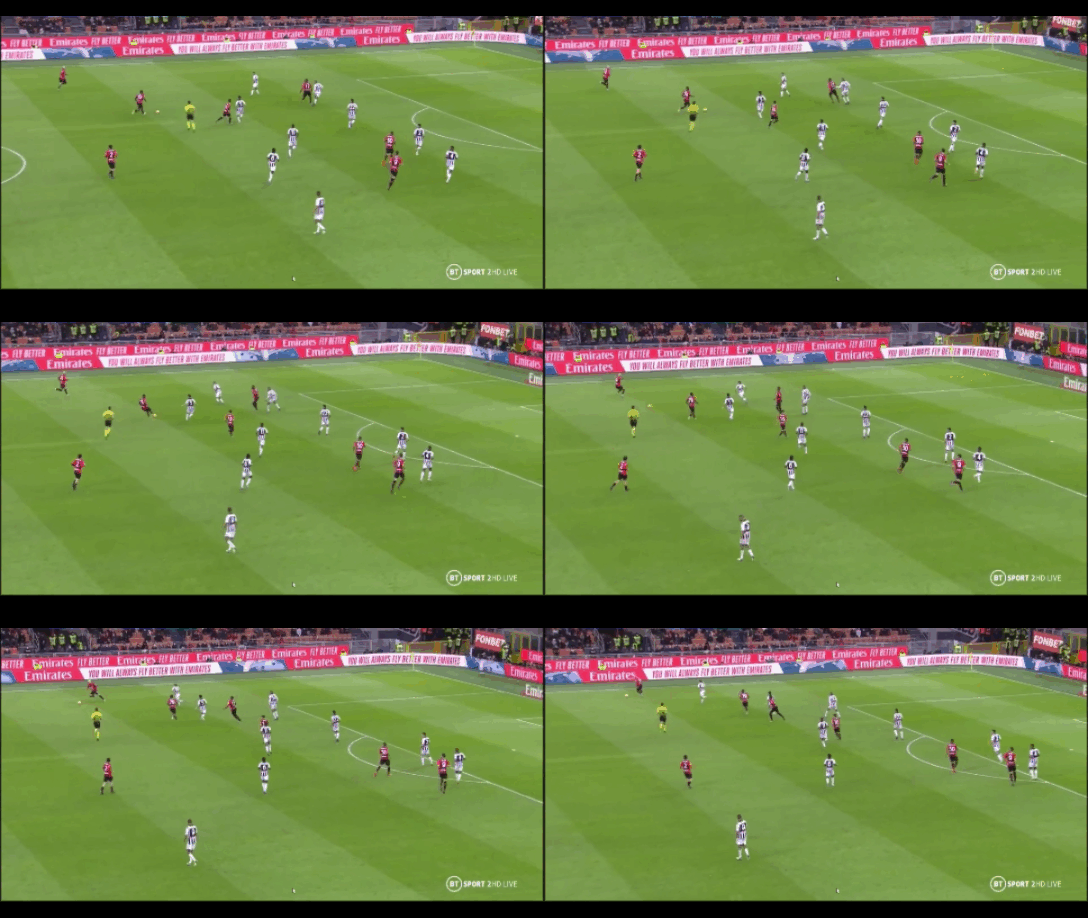
Milan played Udinese on late night Friday in a game they could have extended the lead over Inter but once again Milan could not capitalize on their opportunity and drew 1-1 against Bogey team Udinese. Here a few thoughts that follow from the game
SAME OLD SITUATION, NO ANSWER
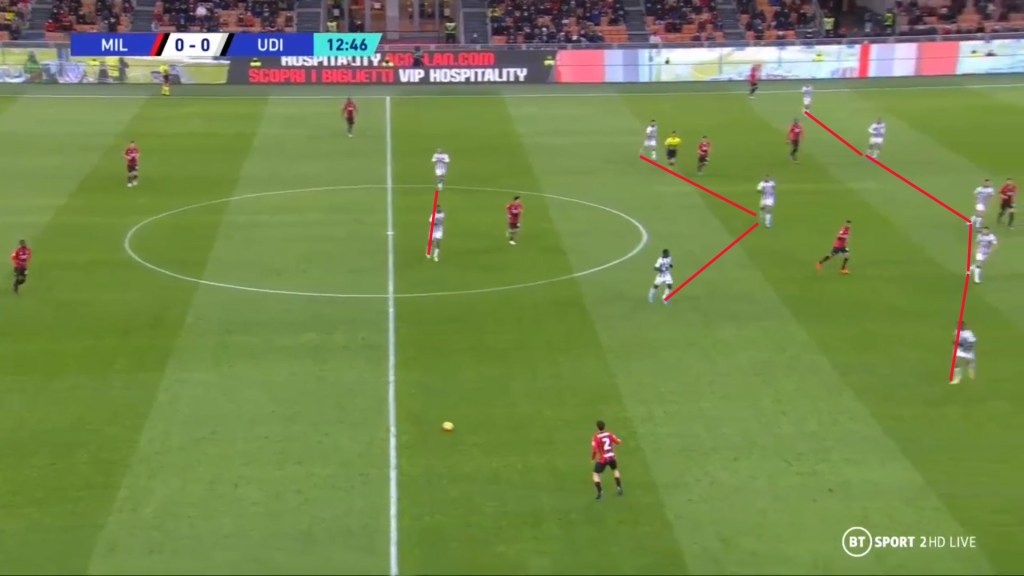
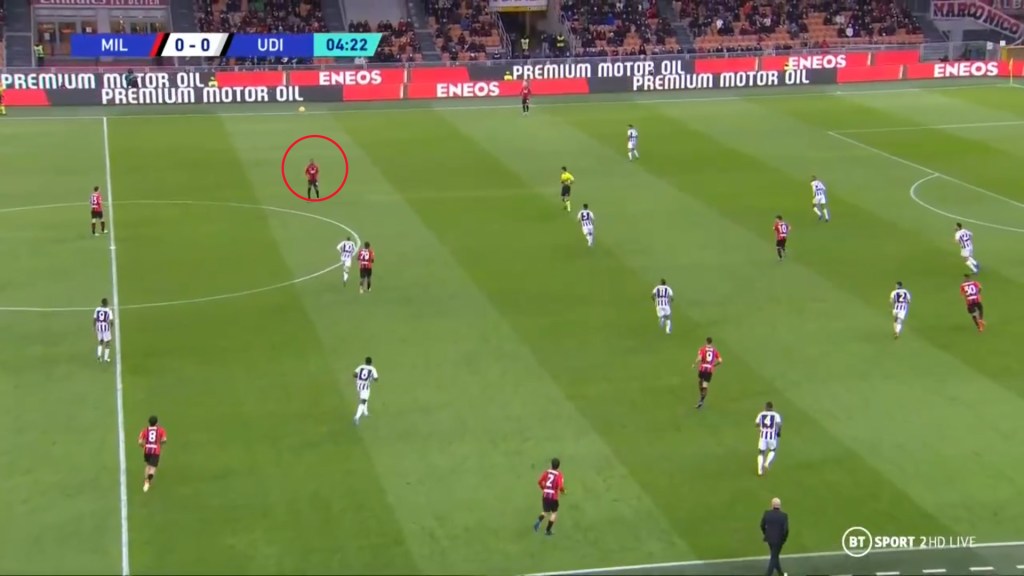
Milan’s nemesis, the deep block or as layman says “park the bus” is back. When Milan fans question why do Milan crumble against smaller teams it is because smaller teams have a different mentality to the bigger sides. You can see how Udinese are sitting in a assymetric 5-3-2 with little or no space for Milan’s attackers.
When we face teams say Inter that play a 3-5-2 like Udinese, Inter play to win, not satisfied with a draw. This means in the course of play spaces will open up especially in the second half when the team is tired. But for a bottom table team like Udinese or Salernitana even a draw is precious making their managers wanting to stay back and defend more and rely on set pieces or individual pieces of brilliance. Milan still need to find a way past this.
MILAN’S LACK OF INTENSITY
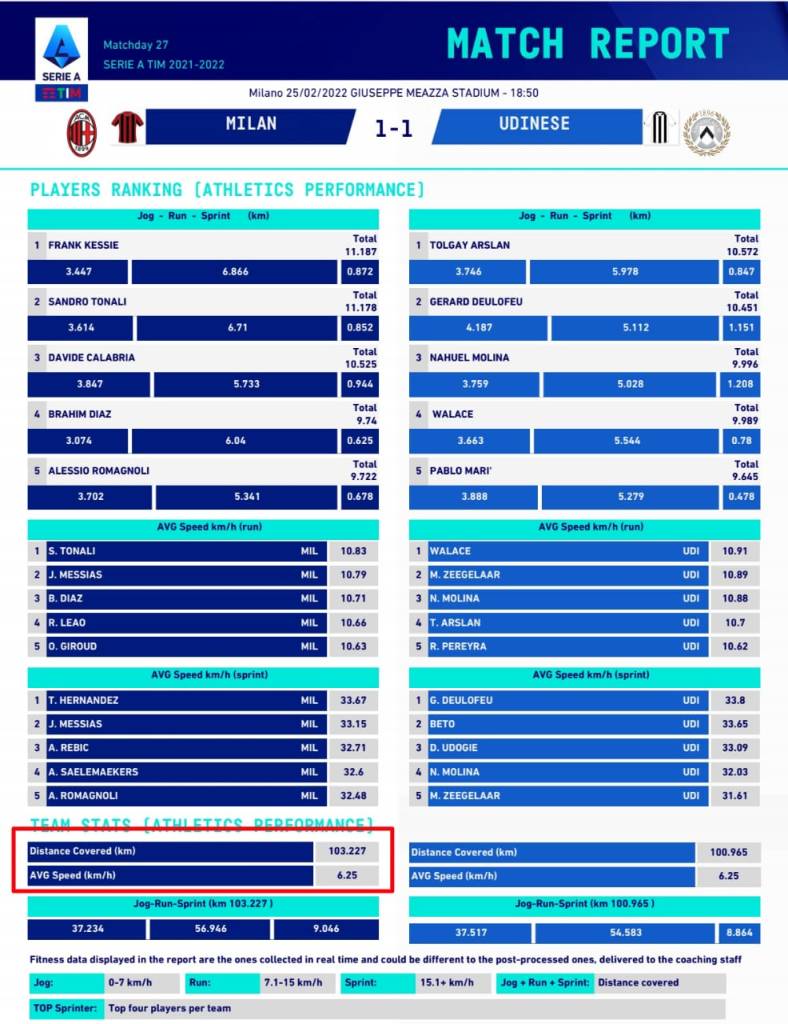
What made Pioli’s Milan standout from the previous Milan and other teams in Serie A (except maybe Gasperini’s Atalanta) was the intensity with which they pressed and played. Milan closed down the space, won the ball and launched quick counters. But then this came at a cost of huge injuries and Milan were in a crisis. Up until Milan’s match against Lazio, it seemed Milan’s intensity was back especially after an energizing derby victory against Inter but the last 3 games have been extremely worrisome. With each game Milan cover less ground and allow more space and time to the opponent. As you can see against Udinese Milan only covered 103km, a very low total considering how we covered 110km easily.
POOR PASSING
When you are progressing through a deep block like that of Udinese’s the most important step is to always move the ball quickly and accurately. Milan were making so many mis-passes like the one shown here which helped Udinese to gain control of the ball and kill our attack.
LEAO FREE ROLE
Unlike last season, Leao has become the go to man for Milan this season. This means that Pioli has given him the license to roam. With Milan’s midfield completely devoid of ball progression and creativity, Leao took it upon himself to come down to midfield and take the ball and beat defenders to create space.
TARGETING TOMORI
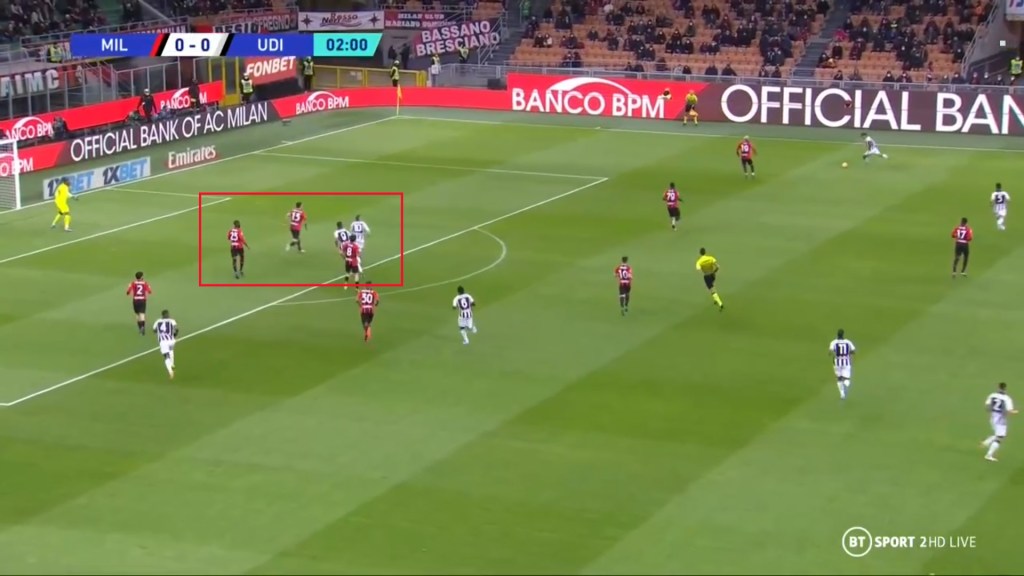
Ever since coming back from Injury, Tomori has been a frail figure of himself. Especially he has been beaten a lot in the air by attackers. Udinese tried it in the early stages where Molina crossed the ball. Deulofeu cleverly drags away Romagnoli who is a better defender of crosses than Tomori and this put Tomori on a 1v1 with Beto. Beto hit the target but it was straight at the keeper.
STATS
For a team that relied a lot on crossing last season it is surprising how Milan barely crossed the ball despite Milan having a competitive #9 other than Zlatan. Giroud barely got any service all game and his frustration showed.
A majorly worrying factor for Pioli and his coaching staff would be Milan’s Expected Goals (xG). Milan’s xG was only 0.7 while Udinese had an xG of 1. It showed how poor we were at creating chances.
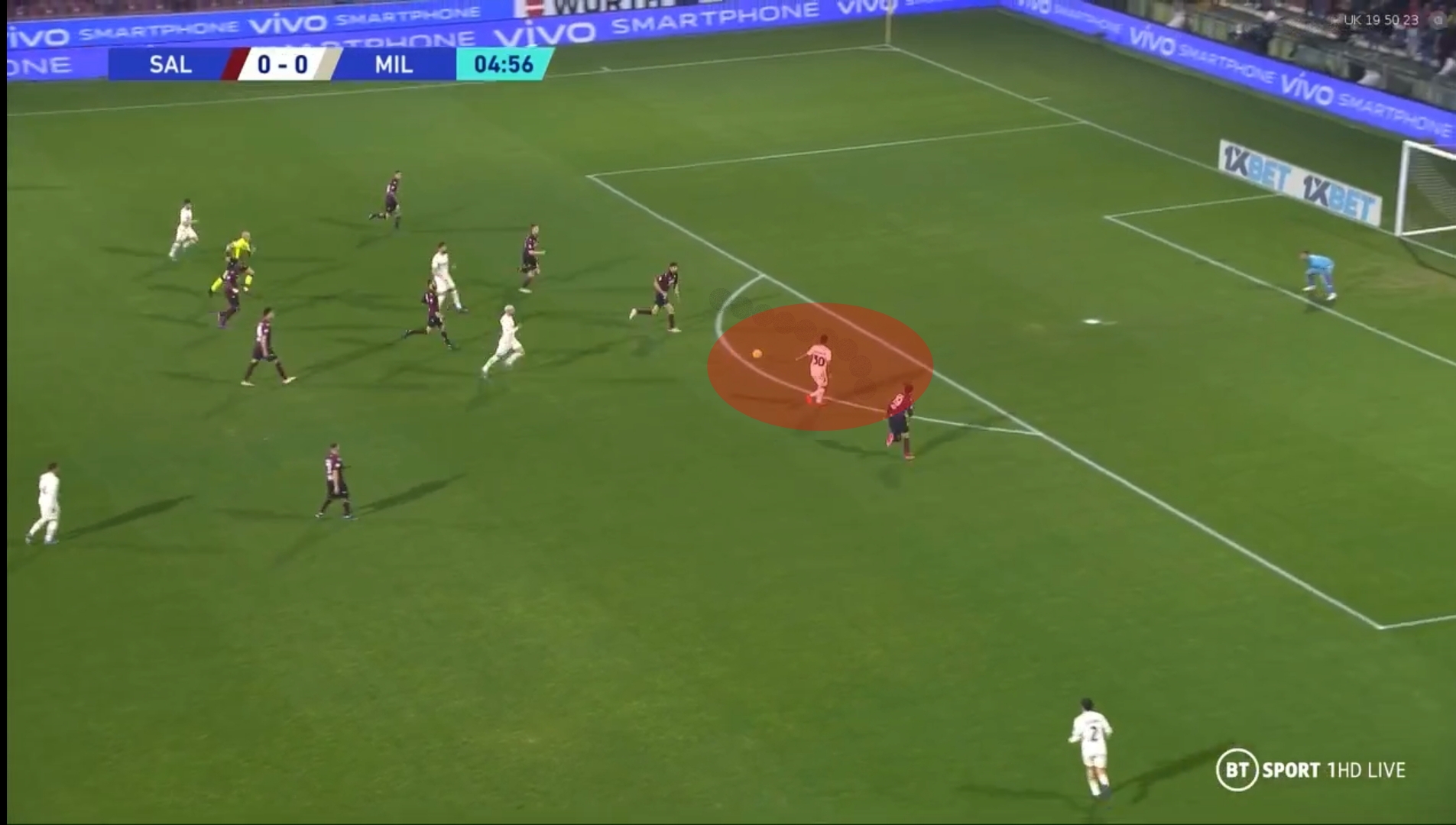
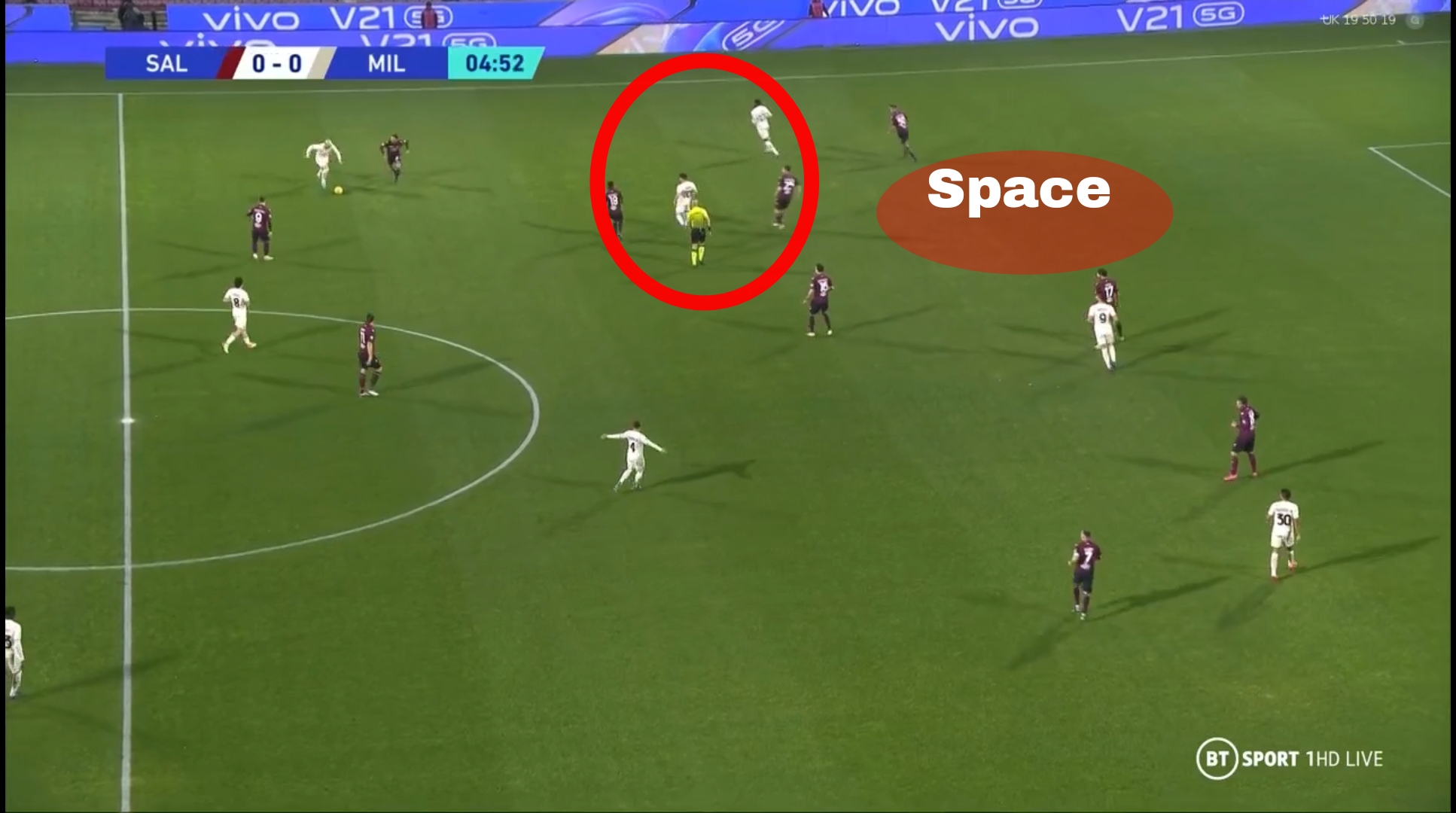
With a chance to extend Milan’s lead over Inter to 4 points and put pressure on a team that was flying high as long as 1 month ago, Milan travelled to Salerno with coach Davide Nicola still finding his way around Salernitana’s optimal set up
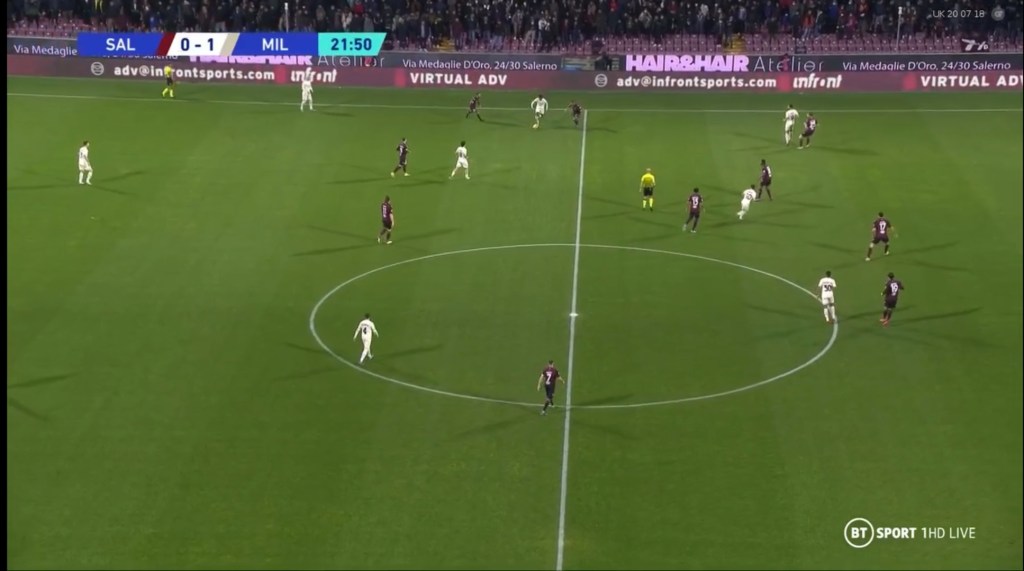
Milan drew 2-2 thanks to a wild strike from Rebic but otherwise put up a very poor display in a week no team in the top 5 league positions won their games. Here is a dive into some of the tactical events from our game in Salerno.
1.POOR DECISION MAKING That pass from Rebic has already flooded social media but that wasn’t the only mistake that Milan made all night. In multiple situations whenever a Milan player had the ball and was being pressed by Salernitana players, instead of passing to a teammate who is unmarked and available the player would try to dribble past his opponent and progress the play. This meant that Milan lost the ball once too many times
2.VERY LESS INVOVLEMENT FROM MIDFIELD Despite playing their best side especially in the double pivot Milan barely used their midfielders to build the ball through the center and tried to build up through their inverted full backs. This meant Milan’s build up was usually predictable.
Milan more often that not build up from the center.
3.CLEVER SEQUENCE OF MOVEMENTS FOR FIRST GOAL Milan’s first goal came as a sequence of clever movements from Giroud, Leao and Diaz successfully pulling out Salernitana’s LWB and LCB out of position. This gave space for Giroud to occupy and he pulled Fazio out of his space for Messias to occupy and receive the pass from Theo.
4.SET PIECES Milan had 7 corner kicks in Total and even more free kicks but could not create a chance from set piece once again. Milan’s frailties from set-pieces are becoming more and more of a worrying factor not only due to poor quality of deliveries and tactics but also with positions taken within the box.
5.INTENSITY Finally Milan’s intensity is something that has to be questioned once again. As per the official record Milan were out-run and out-pace in the game by Salernitana. With no mid-week games or injury crisis, one has to wonder why Milan has had such a drop in intensity.
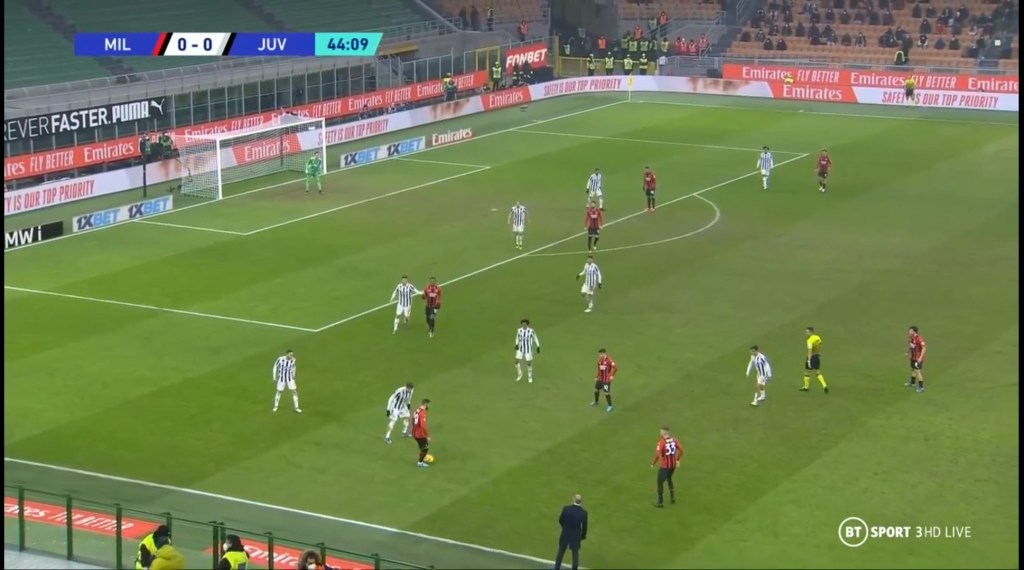
In a battle for Top 4 places, AC Milan took on Juventus at the San Siro admist an injury crisis at the back with Milan’s main 2 CBs injured. Juve were having their fair share of players missing with Bonucci and De Ligt not able to make it for the game meaning Rugani and Chiellini started in defense.
Here are some of the key tactical points.
1. Condition of the pitch
It was a point which was discussed even before a ball was kicked but in the end it was inevitable. Milan’s pass completion rate which averaged around 81%, usually came down to 79% with the ball not travelling as much as usual. Milan were not able to string any passing combinations and we’re going route 1 to Giroud but we’re not able to back him up.
2. Doubling down on Leao and packing the wings
Allegri’s plan was to cut down the wings with Leao and he did that by Doubling down on Leao with Mattia De Sciglio and Cuardado (although he acted as a RW, he was a RWB). Cuardado would double team on Leao and not give him any space to operate.
They packed the wings and prevented any sort of overlap from the full backs.
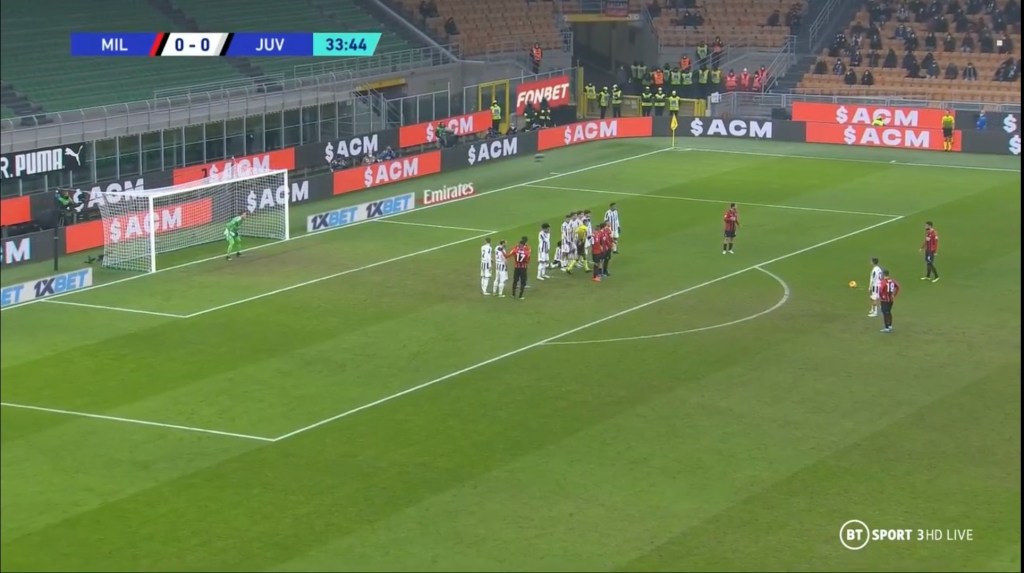
3. Lack of a consistent set-piece plan
Milan ever since the days of Pirlo have not had a consistent set piece taker. While we had Hakan last few seasons he was ineffective and Milan never posed a threat from set pieces. Working on this aspect could help milan unlock stubborn defences.
4. Plenty of Shot creating actions but no Goal Threat
A drab draw at best, Juve had 14 actions that resulted in a shot but somehow not a single shot landed at Maignan or became a goal.
Milan meanwhile had 22 shots on targets off which only 4 were on target.
5. Classic Allegri approach This match had Allegri written all over it with Juve playing more towards protecting their goal than trying to score. And this can be seen at how deep they defender on and off the ball.
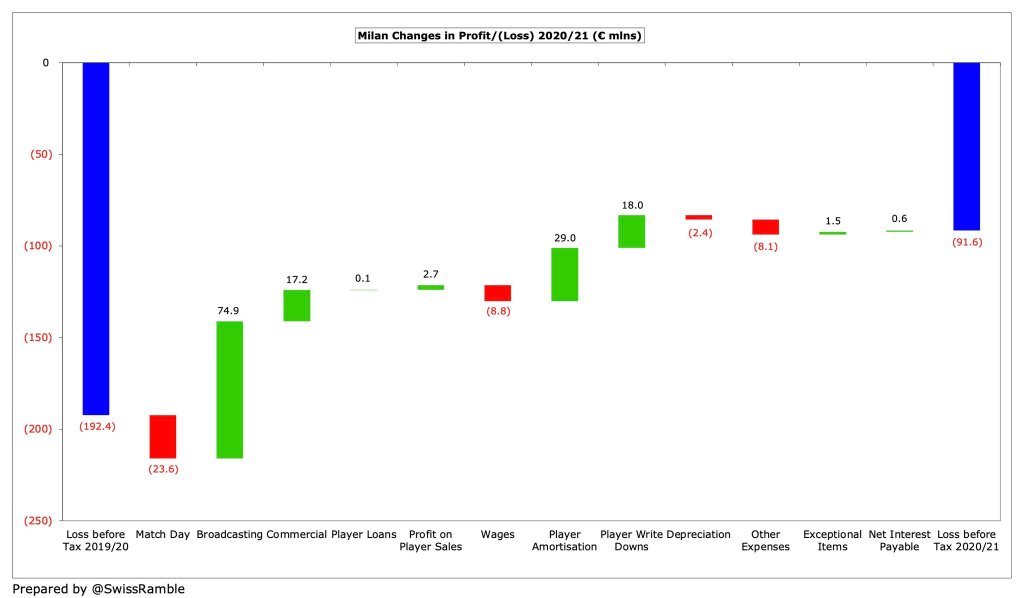
The financials from Milan’s season of achieving Champions League qualification was finally out admist Milan publically announcing a 95 Million loss which was a 100 Million improvement over the 2019/20 season.
With Financial analyst Swiss Ramble breaking down the numbers and splicing Milan’s accounts to delve into how they reached a 95 Million loss, we highlight some of the key points and the positives and negatives from Milan’s finances last year
THE POSITIVES
Milan’s Revenues have increased from 172 Million to 241M. (69 Million increase)
Milan’s tv revenue increased from 63M in 2019/20 season to 138 Million in 2020/21.
Commercial revenues (sponsorship deals, kit deal, advertisments etc) increased from 77M to 94M.
Our Wages to turnover ratio ( wages to turnover is calculated as what % of the total earnings of a club is given as wages) has decreased from 93% to 70%. This means that 70% of the money the club earns is given as wages for players and administrators.
Our Net transfer debt (Net transfer debt= Money we gave to pay to clubs for transfers – Money we have to receive from clubs for buying our players) is 1M. This is a very healthy sign of how Milan have controlled their debts.
Milan’s net interest ( Net interest is the interest a club has to pay for the loans they have availed. For example when we take a loan from the bank we have to pay Interest) has been reduced 23M to only 5M per season.
Player Amortization ( Amortization is the yearly cost of a player’s transfer fee) has reduced from 95 Million to 66 Million.
Player write downs (writing off losses) decreased from 18 Million to 2M (2M loss made on Musacchio)
THE NEGATIVES
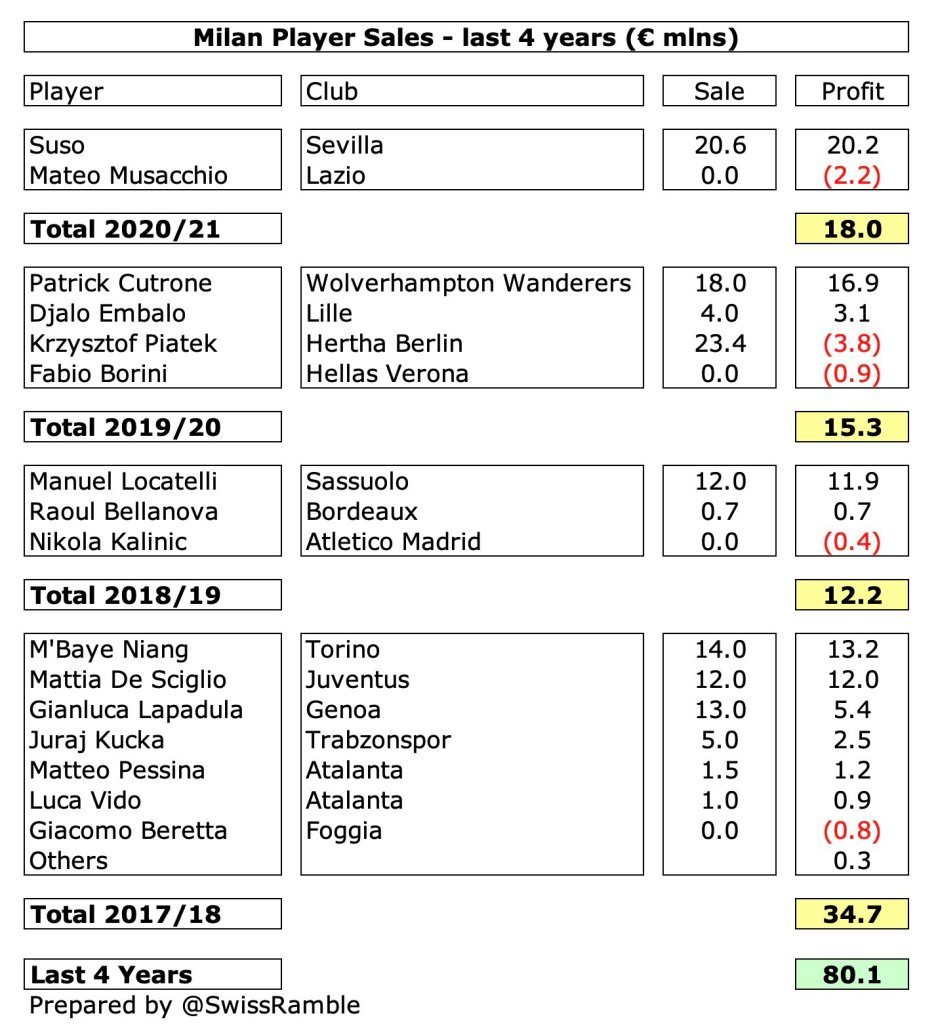
Milan only made a profit of 18M in the transfer window last season (20Million from Suso minus 2M loss from Musacchio)
Wage bill increased by 9M owing to bonuses paid by the club to the players on achieving Champions League qualification. (161 Million to 170 Million)
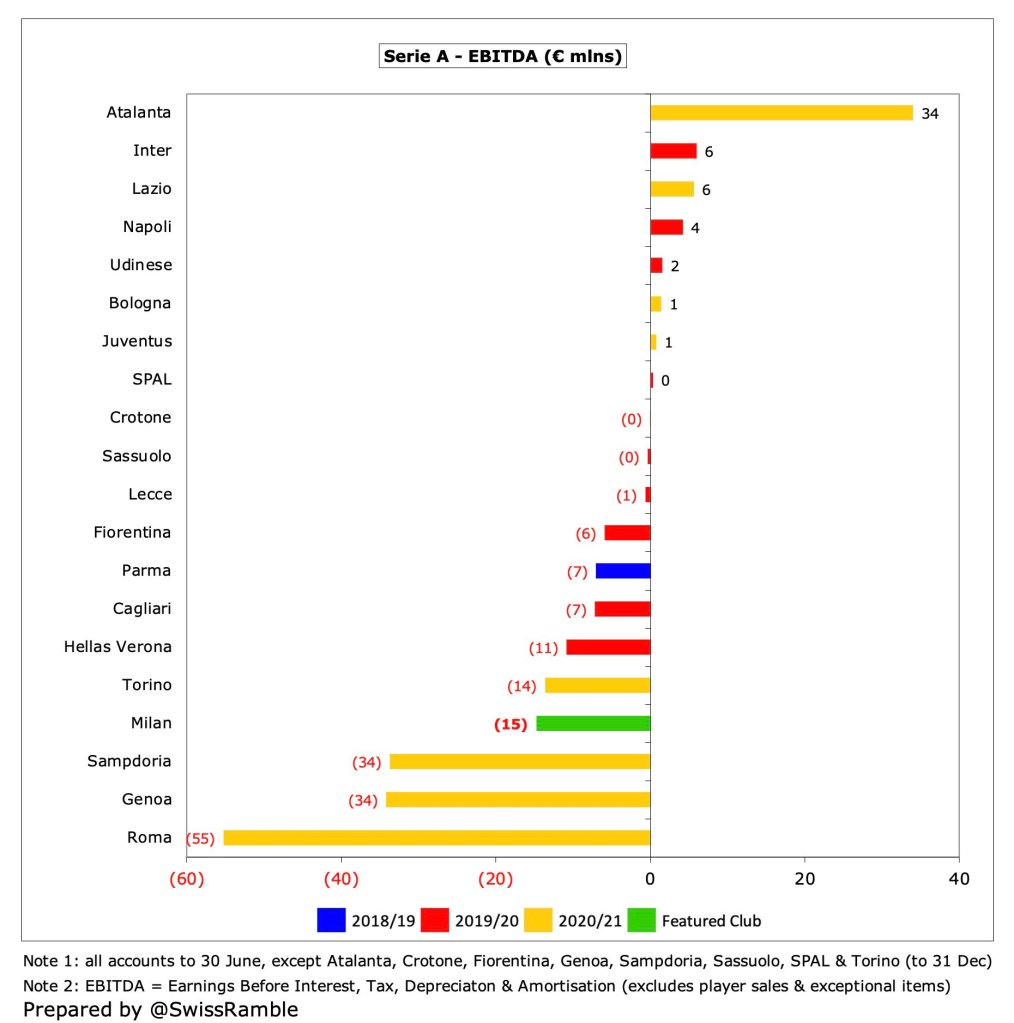
EBITDA (Earnings before Interest Tax Depreciation and Amortization), a real metric to the real profitability of a business because it considers only the core operations of the business (revenue minus expenses like wages, losses in transfer market) is still negative 15M. This is still a metric where Milan is one of the worst in Italy.
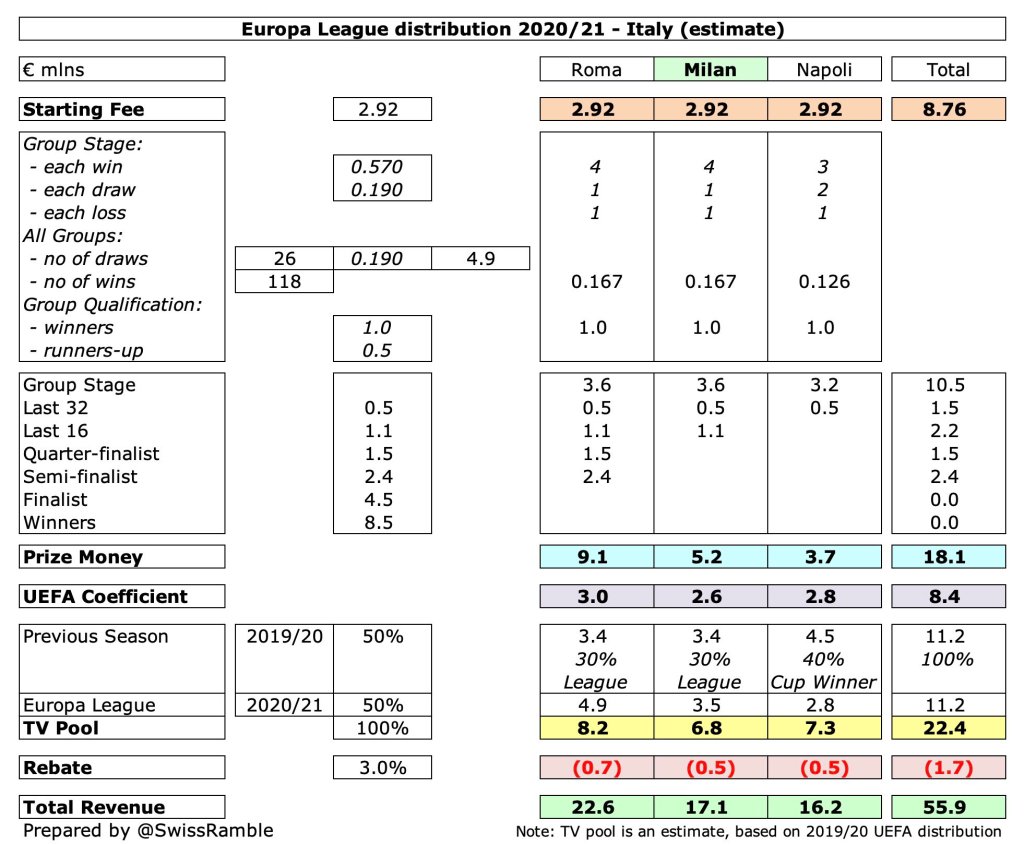
Milan only made 17M from their Europa League performances last season despite making it to the round of 16.
Milan’s gross debt has increased by 10 Million owing to the bank loan availed by Elliot to buy Casa Milan
Milan made 0 Million from Matchday income (stadium ticket sales etc) owing to matches being played under closed doors. However this season will mark a change since Stadiums have been opened up for fans to attend games and Milan can make revenue up to 35M.
WHERE WE NEED TO IMPROVE
Milan’s transfer market activity needs to improve further if they have to make more pure capital gains. They average only 12M profit in the market ever since 2014.
Milan need to consistently make it to the Champions League more as their earnings from Europe have been paltry. While Milan only made 17M from Europe last season Inter made 50M, Lazio 54M, Atalanta 51M and Juventus 83M.
Milan have the third highest revenue from commercial revenue aka sponsorships but they are still a 100 Million behind Juventus. Milan earn only 13M from Fly Emirates which is lower from what Fiorentina get from Mediacom and Sassuolo make from Mapei.
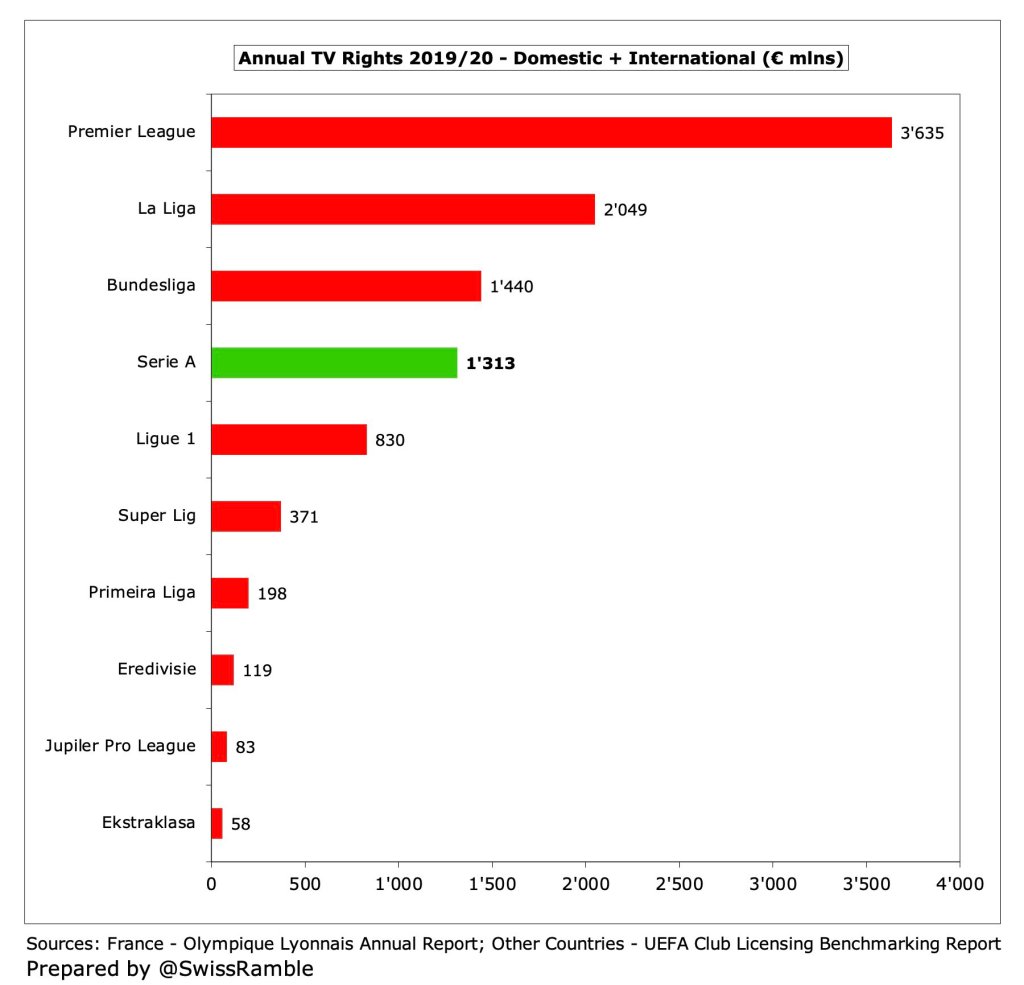
Obviously it is not in the hands of the club but the broadcasting revenue of the league needs a total revamp if they have to compete with the likes of EPL and La liga as you can see from the graph below.
THE THREATS AND ELLIOT’S COMMITMENT
Milan had agreed with UEFA to sit out a year from Europe in 2019/20 season and have a settlement agreement where they will control their finances as per the metrics set up by UEFA.
UEFA asks clubs to cut down their losses to 30M within 3 years. However as per the calculation of Swiss Ramble, Milan have exceeded this by roundabout 273M. Milan have set a meeting with UEFA later in the season to discuss its finances
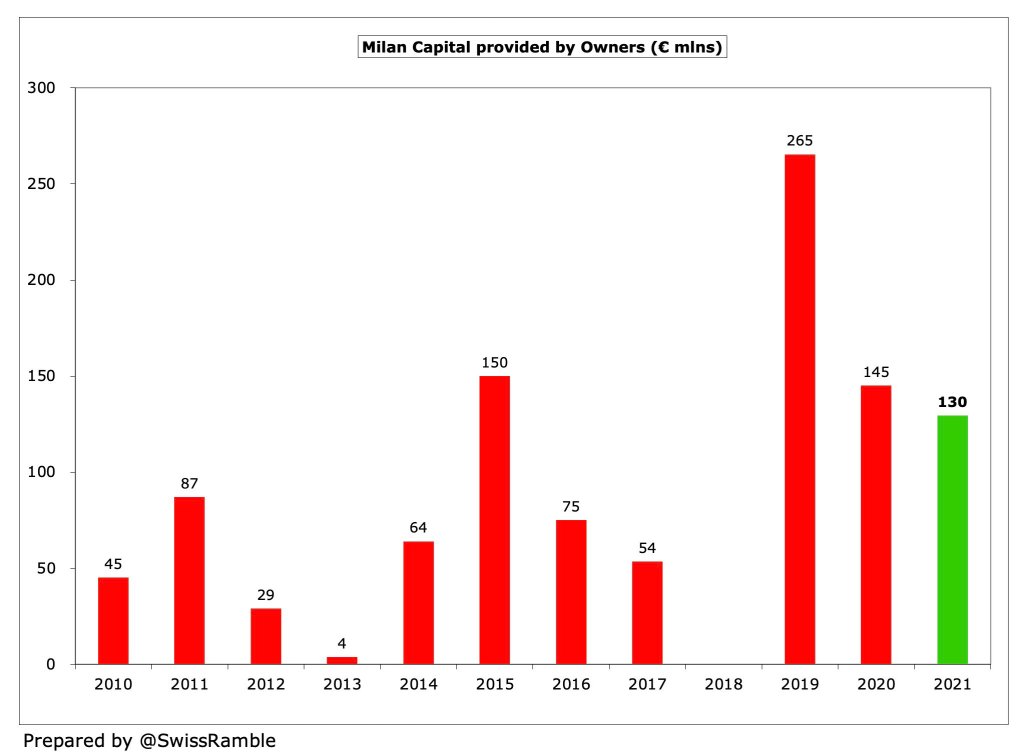
A lot of criticism from fans have been directed towards Elliot for their lack of splurging money towards the club unlike passionate owners. However company accounts indicate that Elliot have spent 130 Million on Milan last season and this has taken their gross spend on Milan towards 540 Million in the last 3 years.
CONCLUSION
Milan have made real improvement ever since Elliot have taken real control of the ship and has somewhat steadied the ship. They have somehow managed to balance performance with financial stability thanks to strong figures in the management in Maldini, Gazzidis and Massara.
However with absolutely no support from institutions like FIGC or even UEFA, Milan are more likely to stay the same with the large possibility of Premier League swallowing football on its own which is why Perez and a group of other clubs proposed the European Super League
Amanda Staveley, Co-owner of Newcastle in an interview stated that the infrastructure of Serie A is not an attractive proposition for investment which itself is a huge threat for Elliot who are in the club only for the medium term.
The only positive factor seems to the approval for the stadium seems to have arrived and a design has been selected. Milan estimates about 70-80M revenue from the stadium alone.
Milan’s €95M isn’t even close to the highest loss in the league. League winners Inter had the highest ever losses in Serie A at €246M followed by Juventus with €213M.
Milan welcomed the Giallorossi to San Siro after the winter break and there was a partial crisis for the home side with the team missing all of its main 3 defenders in Kjaer, Romagnoli and Tomori due to corona and long term injuries. With a makeshift backline, Milan came out with flying colours defeating a distraught Roma who seemed out of idea and after 90 minutes were down to 9 men with a big home game against Juventus coming. Here are few of the noteworthy tactical points
PRESSING
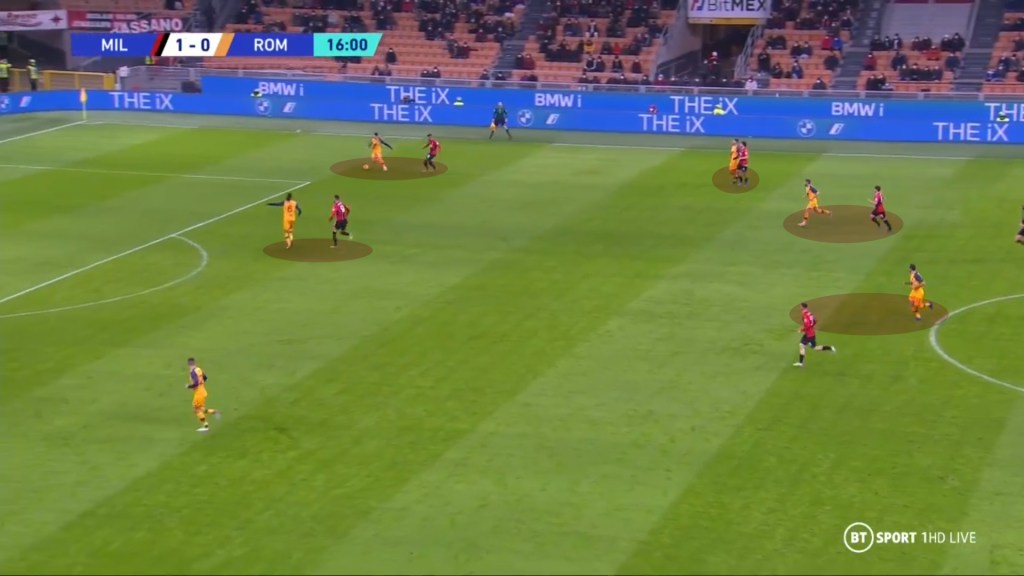
Milan are largely identified as a pressing side and pressing was part of the team that played on Thursday. To the naked eye the second goal seemed like a goal borne from an individual error that came from clever pressing by blocking the passing lane.
Comparing Milan and Roma’s pressing stats Milan made 139 pressures (attempts to press the ball) against Roma’s 145. However Milan’s success % from pressing was 41% while Roma’s was only 33.8%.
For Roma they pressed only in their defensive half and not high up the pitch which speaks to a classic Jose set up. Milan meanwhile pressed mostly in the middle of the pitch (56 times)
4-1-4-1 AND DIAZ-KRUNIC PARTNERSHIP
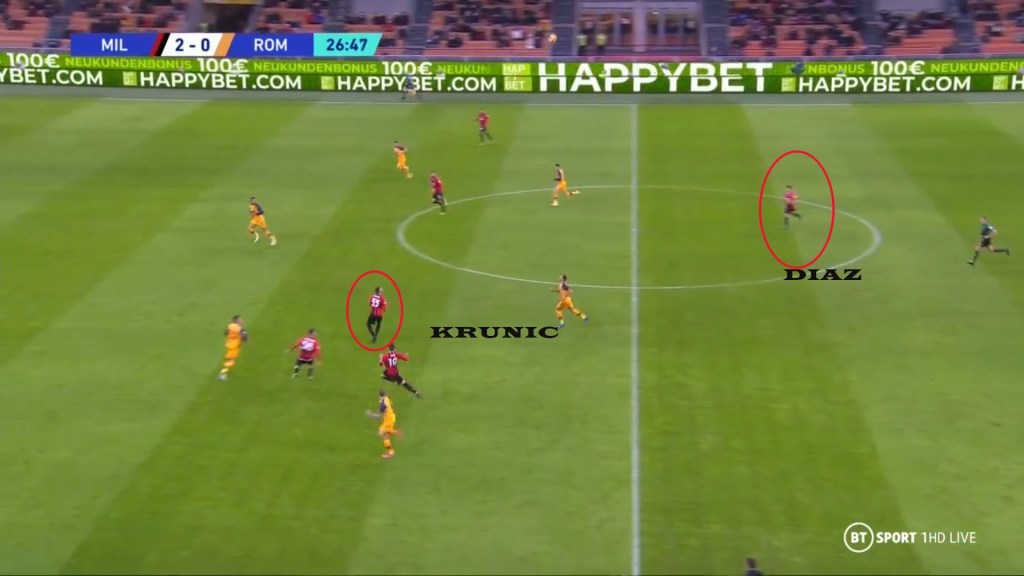
With Kessie and Bennacer gone for AFCON, Milan lined up in the double pivot with Krunic and Tonali . However there was a slight difference in their approach. Tonali would sit back more deeper guarding against counter attack while Krunic would push up to join Diaz and Milan would line up in a 4-1-4-1 formation.
This gave a bit more freedom to Diaz to sit deeper and reciver the balls from Tonali or Maignan and then find his man. This also gave numerical superiority for Milan in the midfield battle given how Roma fielded a 3-5-2
MESSIAS Vs VINA
Milan were always dependent on left wing for Creativity but with Leao injured and Messias fielded on the right, Pioli focused on the right. Identifying Vina as the weakness in the 3-5-2/5-3-2 lineup of Roma, Messias was tasked with taking on Vina and beating up. Messias was able to do this on many occasions even drawing a frustrated challenge from Vina but went unpunished.
QUALITY OVER QUANTITY Milan had 3 shots on target out of 17 they made in the match while Roma had 5 out of 11 shots. This maybe speaks about how Roma was taking their chances. However the xG or expected goals tells a different story. Milan’s expected goals stood at 2.9 while Roma’s expected goal was 0.8 which speaks to a superior quality of chances that were created.
Milan also had 23 Shot Creating Actions (SCA) while Roma had only 9 which once again points to the disparity in the control of the match.
CONCLUSION Milan put their covid issues behind them as they dominated San Siro and showed Roma some real quality high octane football while Roma were kept at bay for large parts of the game.
Losing 2 key players through suspension against Juventus would be a real challenge but in Mourinho never count the Giallorossi out.
Milan travel to Venezia with sky high confidence and best of all with all of their injured attacks back and some of them firing.
Milan succumbed to their first defeat away to Fiorentina at the Franchi as Milan’s Achilles heel in coach Vicenzo Italiano scored another win over Pioli, this time with Fiorentina (last time with Spezia).
But contrary to popular belief Milan actually outplayed Fiorentina in almost all departments except in the goals. So where have Milan gone wrong? Where did Fiorentina get it right? Let’s take a look.
FIORENTINA LINE UP
Fiorentina like Italiano’s Spezia lined up in a 4-3-3. This meant that Fiorentina had 2 extra midfielders in buildup and attack while a single pivot in the center protected the goal.
FIORENTINA’S BUILD UP AND WING PLAY
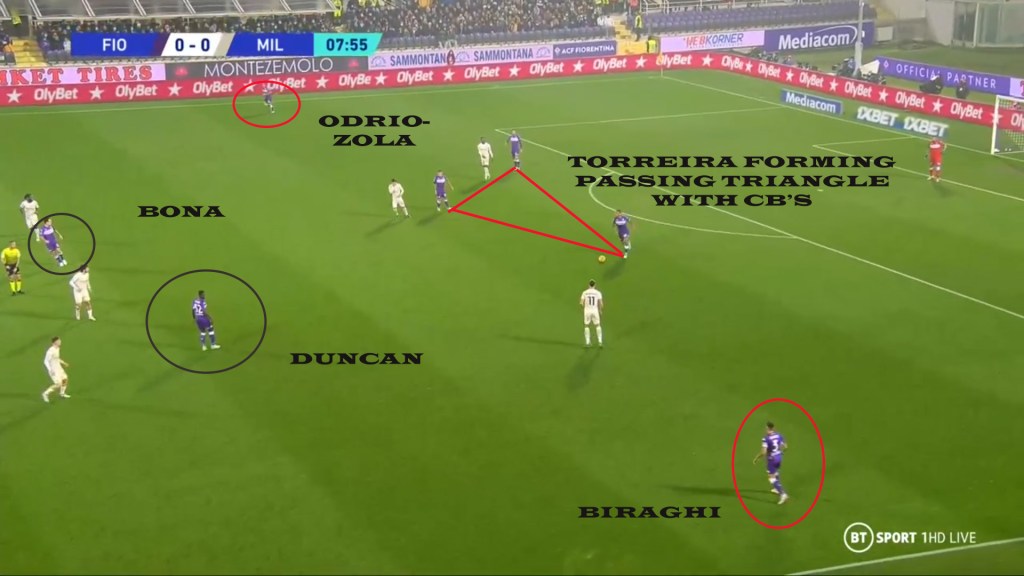
Fiorentina used Torreira as a single pivot forming a passing triangle at the back. This helped Fiorentina’s full backs push up and pin Milan’s wingers away from where the build up was happening. Since Fiorentina was playing a 3 man midfield Torreira was flanked by Duncan and Bonaventura on either sides. In reality Fiorentina build up using a 2-1-4-3 or at times a 3-4-1-2 with Vlahovic dropping off from his position and acting as a makeshift AM.
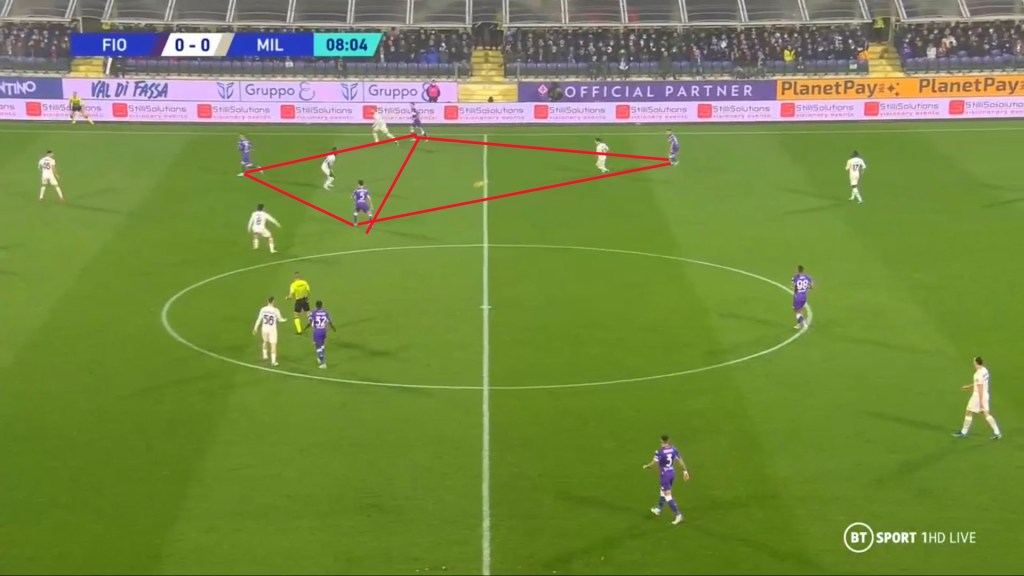
Once again owing to their structure of a 3 man midfield it helped Fiorentina to overload the wings and create passing diamonds. Diamonds, unlike triangles gave the man in possession even more options
MILAN’S NARROW FORMATION AND SWITCHES OF PLAY
Milan as usual played a very narrow formation to reduce the playing area press Fiorentina but for Fiorentina they have effective midfielders and functional full backs.
Using the full width of the pitch Fiorentina initiated quick switches of play that turned’s milan of playing a narrow formation into a quick disadvantage as it turned into many attacks for Fiorentina but somehow they weren’t able to convert
THE HIGH PRESS, HIGH LINE AND OFFSIDE TRAP
Italiano like many modern coaches is a forward thinking coach who likes his team to press forward and not give the team on the ball any space. With a functional #10 like Brahim this meant that there would be space between the lines particularly with Fiorentina committing numbers to the high press.
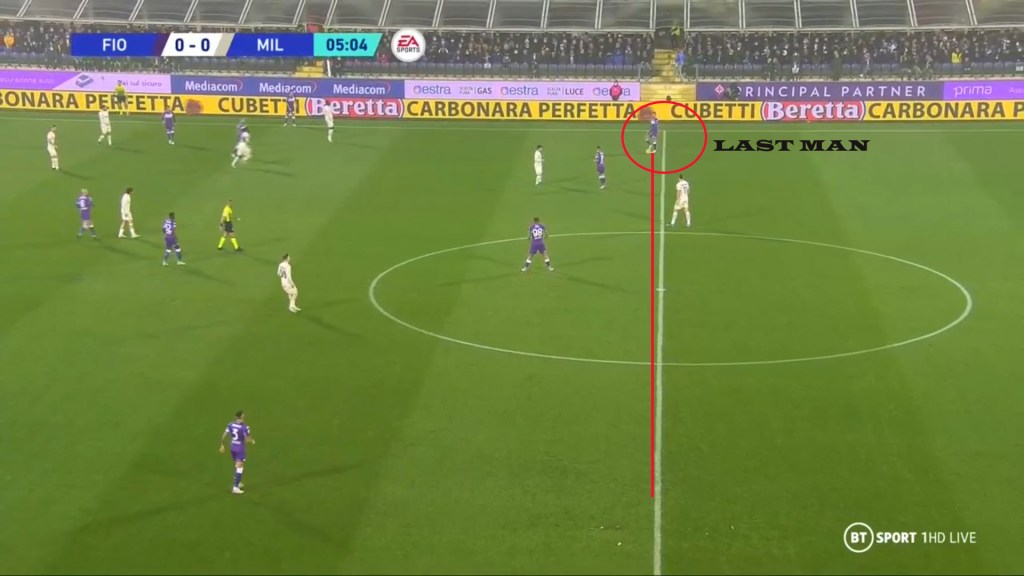
To close the spaces Fiorentina played a high lines and maintained 15-20 meters between their first line of defense and their last line, usually Vlahovic. Give the team very less playing area.
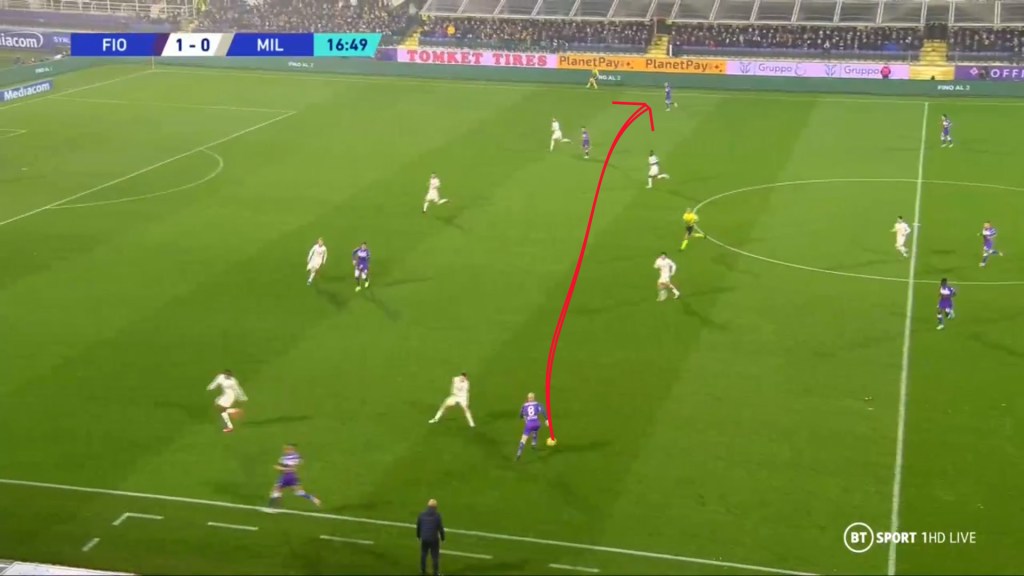
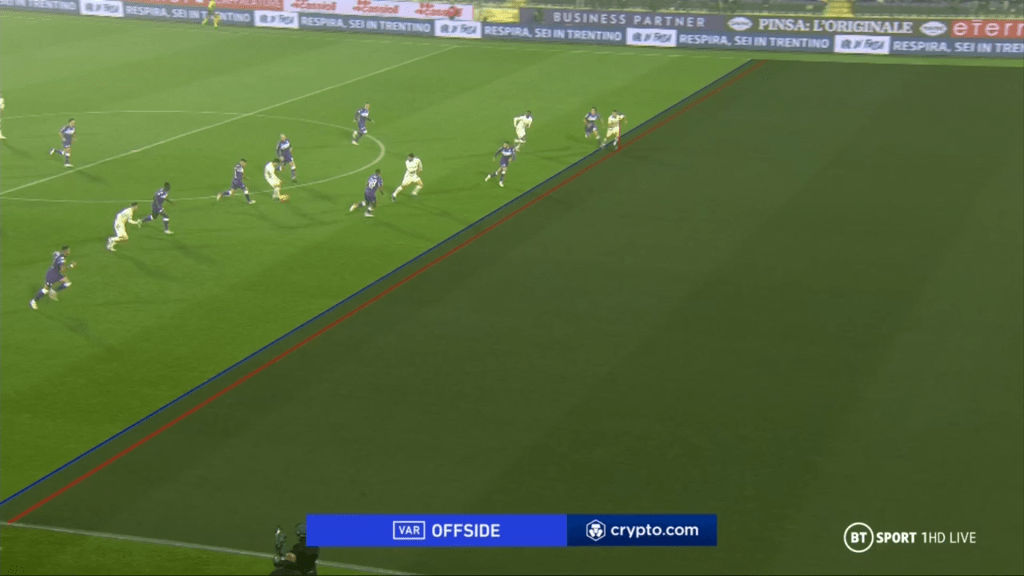
Milan tried to exploit this using Simon Kjaer’s ball playing ability and kicking balls above the lines of defense to a tall Ibrahimovic but Fiorentina played the offside trap very well which is rather a very difficult technique.
FIORENTINA’S 4-3-3 ADVANTAGE AND THE WEAK LINK
Fiorentina committing more men forward had its advantages. For examples it helped in created so many overlapping situation between the winger and the wide midfielder or it helped in overloads of the wide area
The second goal, although it came courtesy of a stunning piece of work from Saponara, was caused by a series of movements. Duncan underlapped Biraghi and pinned Kalulu to the wide areas creating a space between the CB and Kalulu. A poor clearance from Tonali was pounced on by Vlahovic who laid it off from Saponara and Kjaer couldn’t cover the space to shoot.
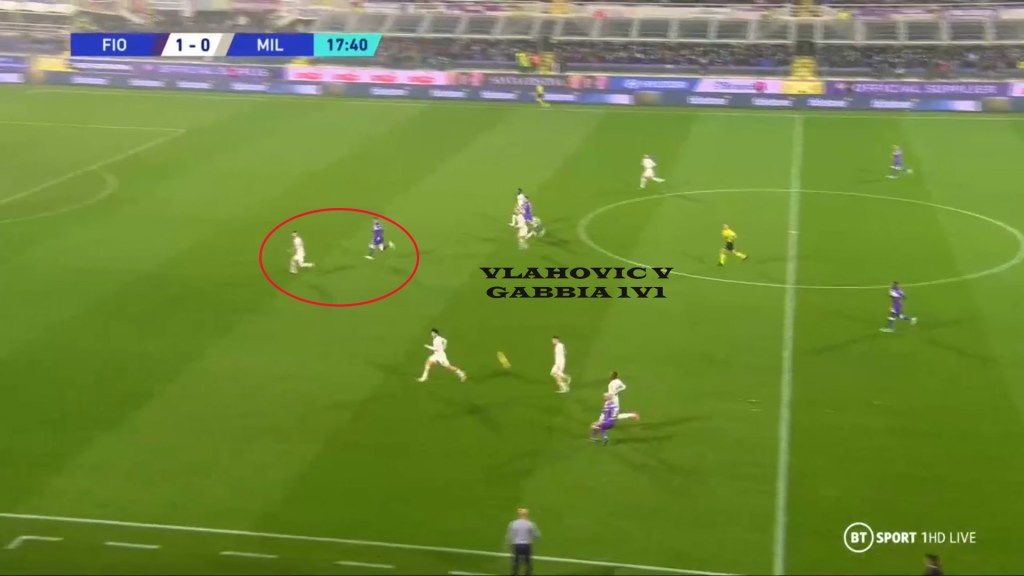
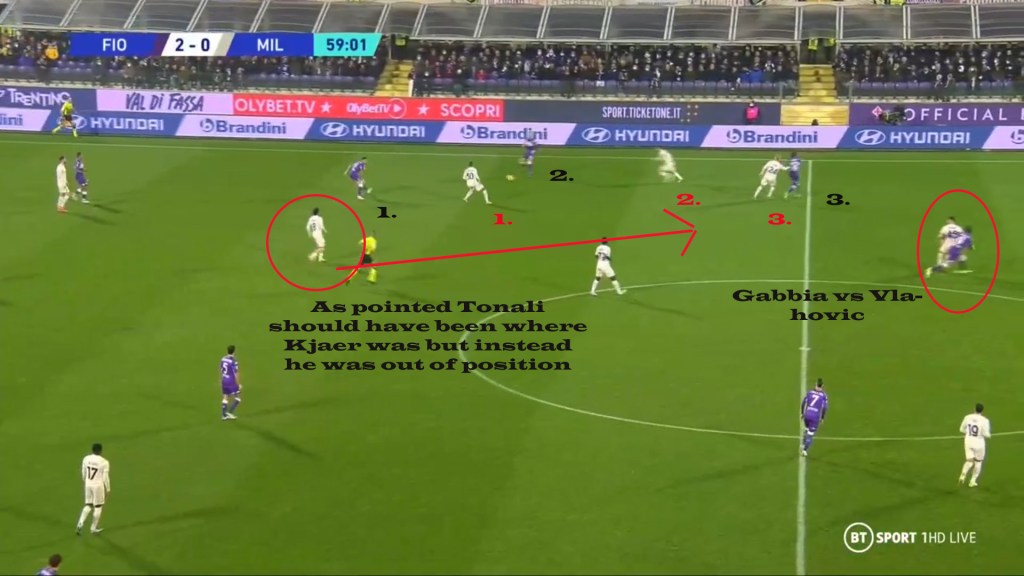
Gabbia came under a lot of criticism for his performances against Fiorentina, a lot of it justified. Fiorentina (not sure if they were aware if he would play) targeted Gabbia with Vlahovic constantly on his shoulder creating trouble for Gabbia more than once.
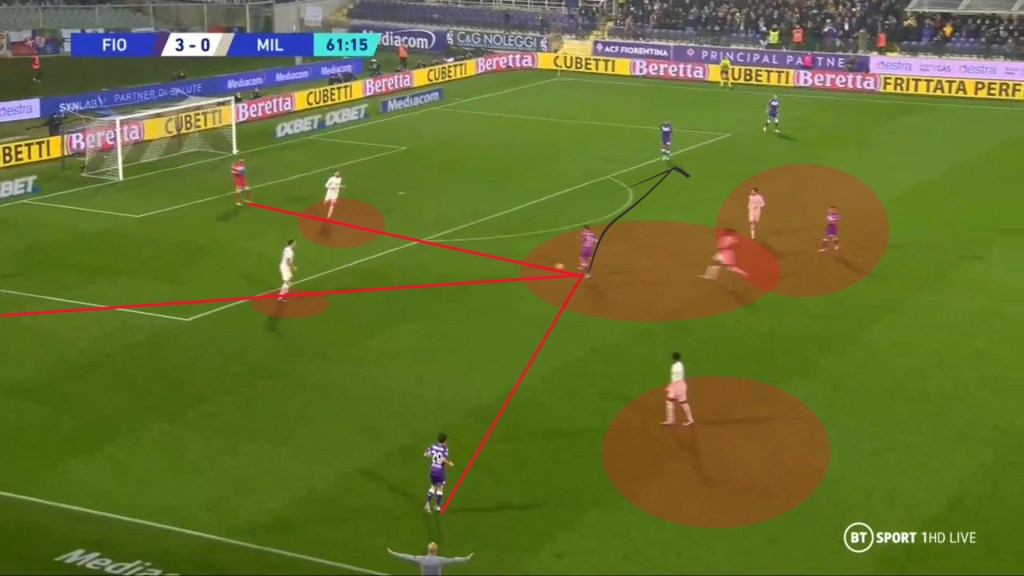
The third goal came as a result of Fiorentina’s structure and clever targeting. Initially Fiorentina created an overload in the wide area by having Bonaventura, Duncan and Saponara push on Messias and Florenzi making it a 3v2. While Tonali played on the right side of the double pivot he was out of position in this particular sequence of play. This meant that Kjaer had to go across to even the odds and this put Vlahovic on a 1v1 vs Gabbia. Gabbia couldt match Vlahovic’s pace and power and Vlahovic made it 3-0 for the hosts.
SMART PRESSING
Milan’s first goal came as a result of some smart pressing. To ease the pressure of his Keeper Bonaventura came of his position and received the ball. However this was a trap. Milan had cut off all the passing options of Bonaventura. Ibra covered Venuti, Giroud covered the keeper, Tonali covered Torreira, leao covered Odriozola and Kessie pressed Bona to pressure him to making a quick decision. Rather than risking a long pass with his left foot (weak foot) Bona decided to risk the pass to Venuti and this, as we all know turned out to be a mistake.
THE STATS
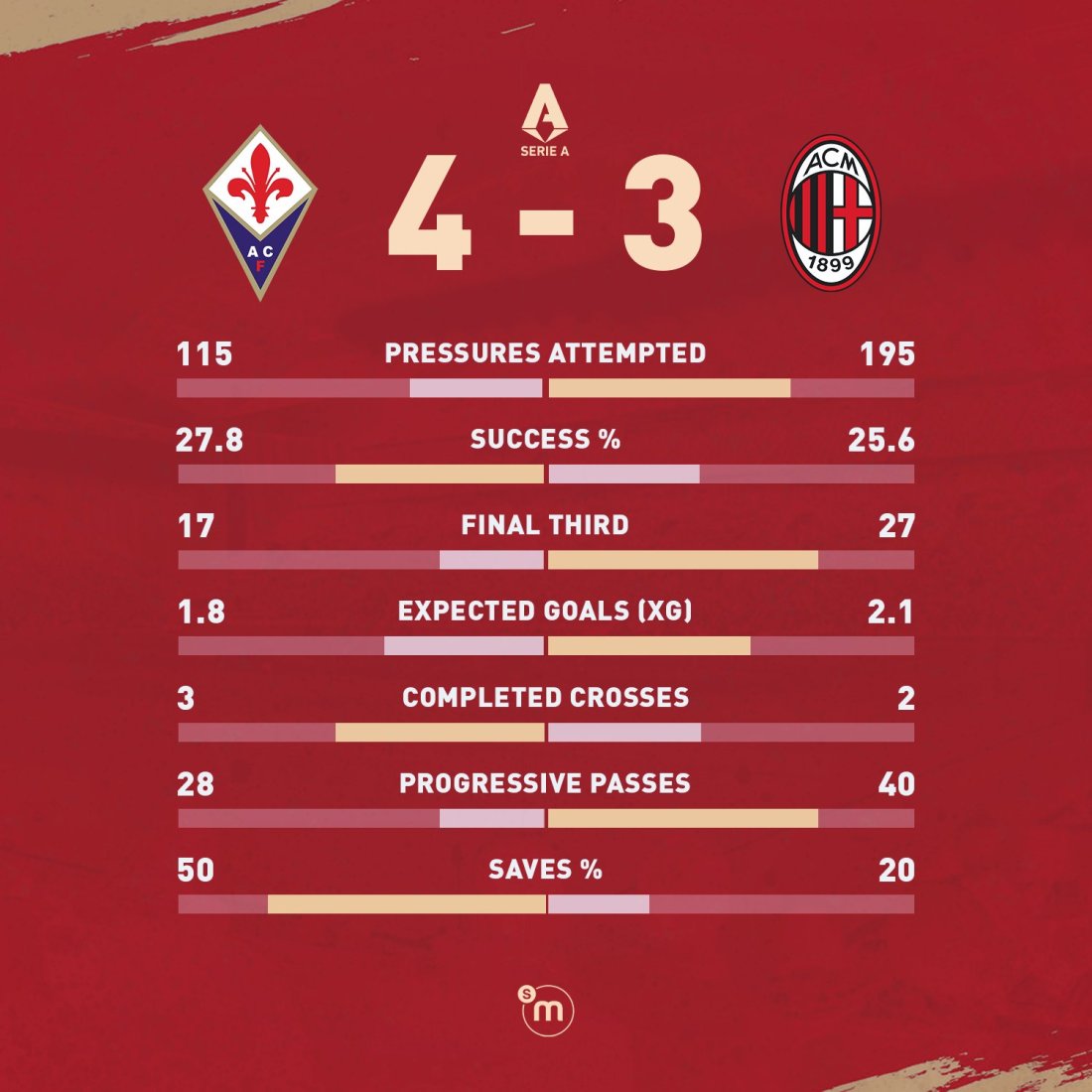
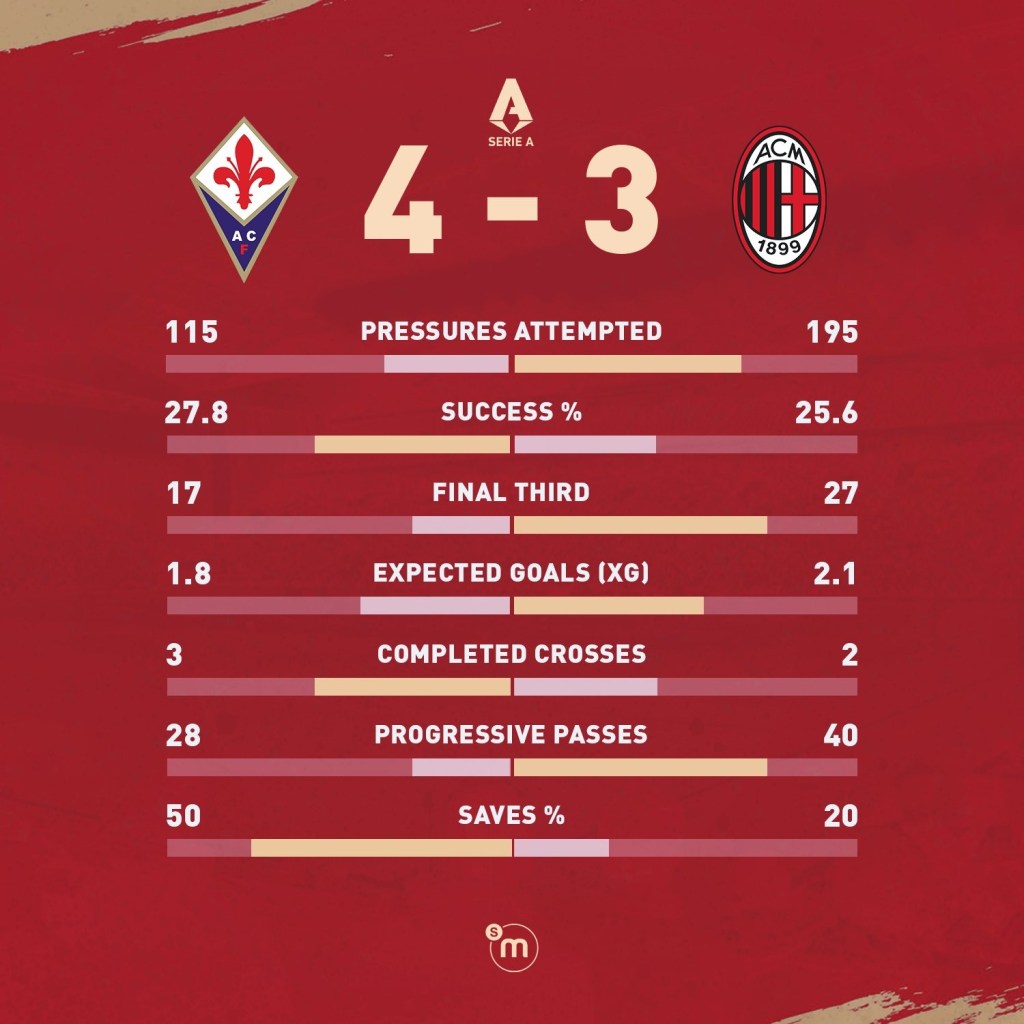
The Statistics from Fiorentina Milan however paint a different picture from the Score line. Milan played Fiorentina out of the park and should have by all means won the game but alas Milan wasted their chances
As we can see above xG or expected goals are a metric to quantify the quality of chances created by a team. Milan scored an xG of 2.1 while Fiorentina only had 1.8. Further proof of how Milan were wasteful in front of goal
Milan made 40 progressive passes (passes that are not sideways or backwards) and completed 27 passes in our final third while fiorentina only registed 28 progressive passes and 19 passes in their final third
The only area where Fiorentina seemed to better Milan was in terms of their pressing which kinda seems skewered because Milan, who were chasing the game from the 13th minute pressed relentlessly and attempted more pressure compared to Fiorentina.
The most disturbing analysis is the save % of the keepers. Tatarusanu saved only 20% of the shots on target he faced while Teracciano saved 50% of all shots on target
In an early kickoff, Milan took on Spezia at La Spezia 3 days before their return to the Champions League at San Siro to take on Atletico Madrid. Spezia came on the back of a narrow defeat to Juventus as Thiago Motta has shown to be promising coach and Milan had a few injuries and niggles to contend. The good news was that Giroud was back in the starting XI while Daniel Maldini made his first ever start for Milan in Serie A at the age of 19. Here are a few points from the game at La Spezia.
Fatigue a real concern
Milan have a heavy schedule and play almost every 3 days. They have played 3 games in the space of 6 days and with injuries piling up Pioli has very little to rotate with. This means that Milan have to keep their intensity low and win with minimal efforts in order to conserve energy in the long run. And this can be seen in the Atheltic data. Milan only covered 97 kilometres against Spezia while they covered 103 km against Lazio and 105 kilometres against Juventus. It clearly shows a drop in fitness levels.
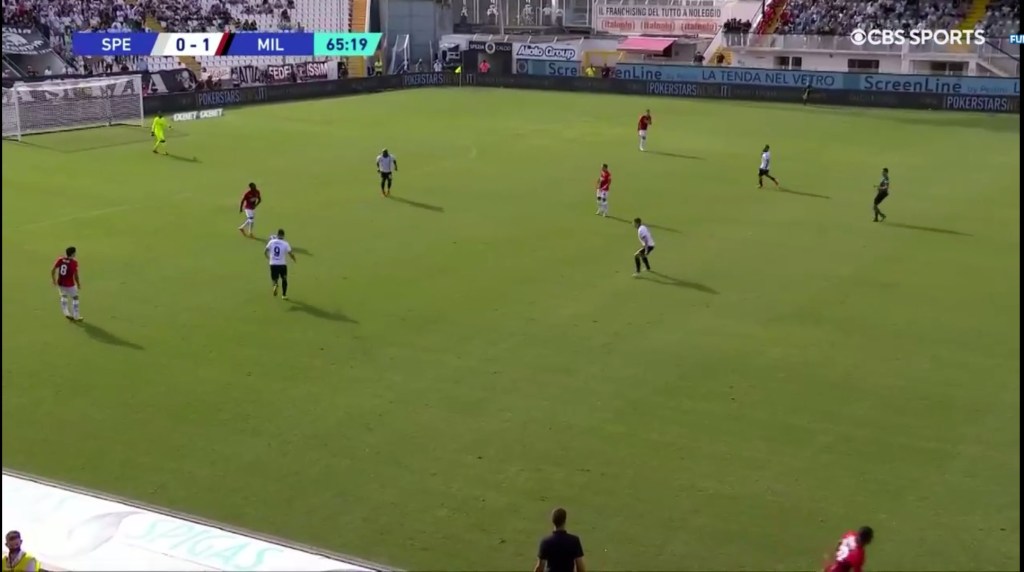
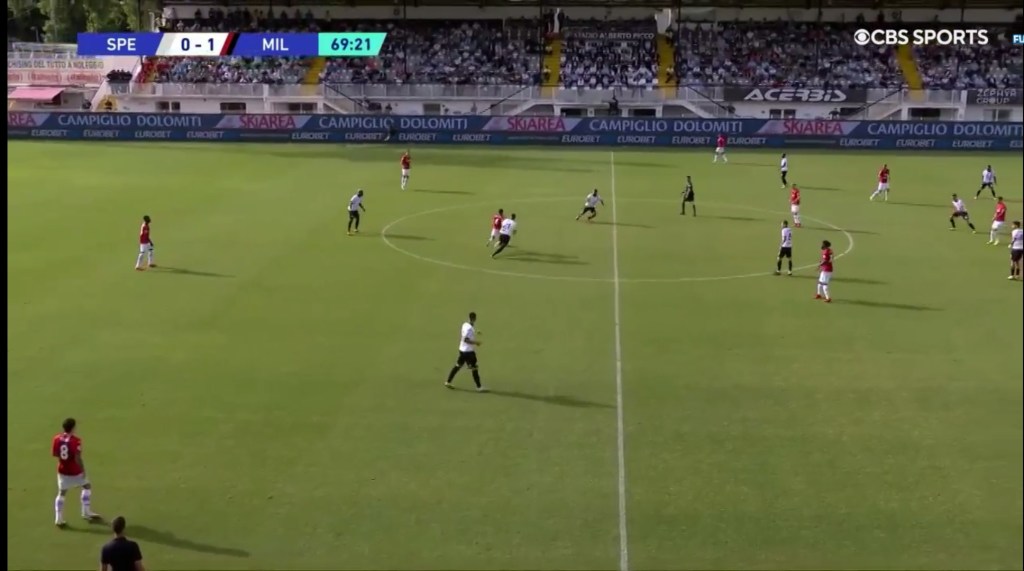
Spezia and their high press
Spezia under Motta did not play like normal low-tier teams. Instead they pressed Milan high up the pitch using man-oriented pressing and force Milan defenders to make a mistake.
Spezia’s high press
Pioli countering the high press
Pioli countered this by having his Center split far and wide and having Tonali play as the 3rd Center back while bennacer sat back as a creative midfielder while Kessie, Saelemaekers, Theo, Leao and Kalulu/Calabria pushed up. Pioli gave Saelemaekers quite a free role where he would drift into the center from the right often being a passing option to help make the transition from defense to offense.
Tonali sitting as the 3rd CB while Tomori and Alessio are the CB and LCB whole Bennacer acting as the DLP. Watch how Theo, Leao, Kessie and Pellegri are in Spezia’s half unsettling their defensive shape
The leao effect
While Leao did not contribute directly towards any of the goals his ability to beat defenders and take them out of the game is important in setting up chances. For Milan’s first goal Leao’s move to beat his marker and pull his opponent out of position before he could prevent leao’s pass to Kalulu gives us a fair idea as to why Pioli still has faith in the youngster
The deadly counter attack
In a prelude to what we can expect from Simeone’s Atleti in San Siro on Tuesday evening, Milan maintained a high line against Spezia which was breached quite a few times only for Tomori’s or kalulu’s pace to save the day. Against atletico this may not be the case as the attackers in Madrid are far more gifted physically and mentally to take their chances and this would be something Pioli would need to work on.
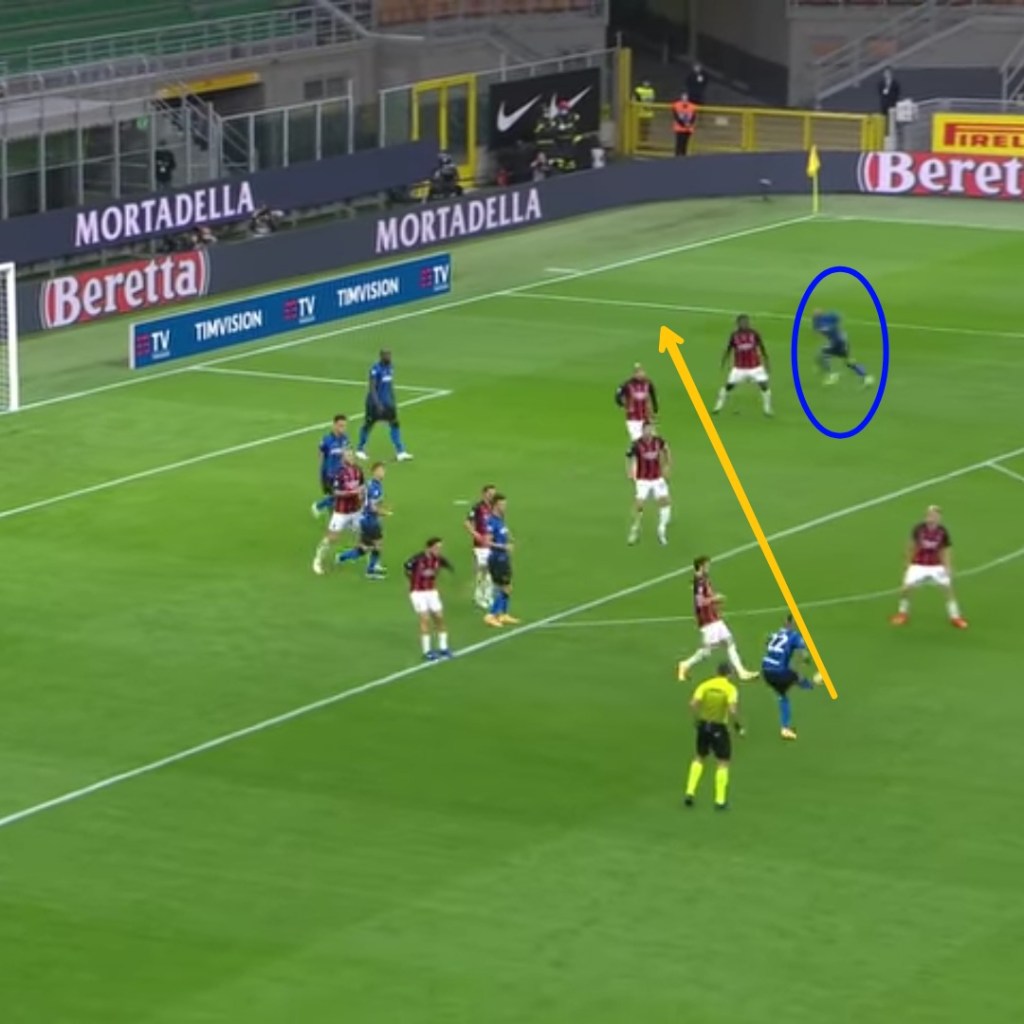
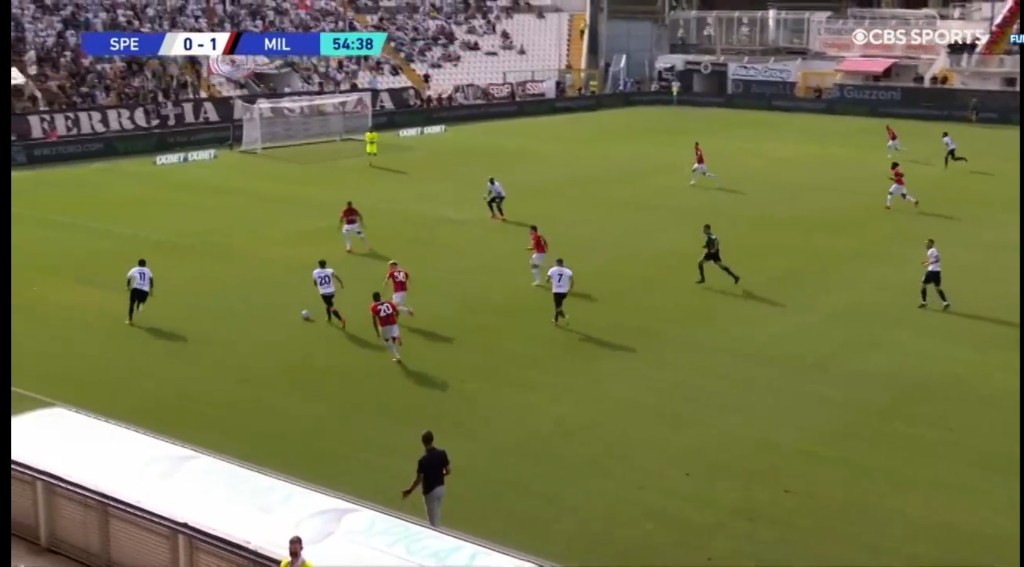
Spezia putting in balls behind the Milan defense
Another chance creation technique Spezia used was to create 2v1 on the wings wih Bastoni and Gyasi to create crossing situation. One such situation is the one that led to the goal while the other chance ended up with Maggiore missing a sitter

















 The Milan Blog