

The accounts for Milan’s 2019/20 were released for Public viewing by the club (as is the policy of all Pvt Ltd and joint stock companies) and popular Football Financial Analyst, The Swiss Ramble spliced the company accounts to analyze the company’s performance in the onset of economic meltdown following the Covid-19 pandemic.
Now with this article we summarize their findings and give our verdict on Milan’s performance off the field.
To give a better understanding, I have classified all the data under various overheads
GENERAL OUTLOOK
Overall Milan’s loss before tax is reported at 192 Million for the 2019/20 season. It increased from 143M to 192M (49M increase). The increase in the loss is mainly attributed to Milan’s revenue decreasing by 56M even though Milan’s expenses have decreased.

Milan’s loss is the second highest loss in Italy only behind Roma who recorded 204M, Inter 102M and Juventus 90M.
In Europe Milan once again only trail behind Roma In terms of highest losses being 2nd on the list,
With this year’s balance sheet, Milan’s accumulated losses for the last 7 years have gone up to 735M in 7 years.
Operating loss defined as the Operating Income minus Operating Expenditure (Operating income or expenses does not include player’s amortization, profit from player sales and disposal of assets related to extraordinary activies of a football club) for Milan increased from 144M in 2019 to 202M in 2020. However Milan’s Operating loss is not the highest in the league as pretty much all clubs in Serie A operate on loss
TV REVENUE
Milan suffered highest fall in Income in terms of TV broadcasting revenue. In 2018/19 season the club earned 105 Million which has reduced to 63M in 2020. This fall can be attributed to a poor showing in the league, lack of European competitions and Corona deferring payments from broadcasters. Some of the broadcasting revenue will be added to the 2020/21 season accounts.

When seeing the big picture Juventus earned 166M, Napoli earned 121 Million and Inter earned 112 Million last season.
MATCHDAY INCOME
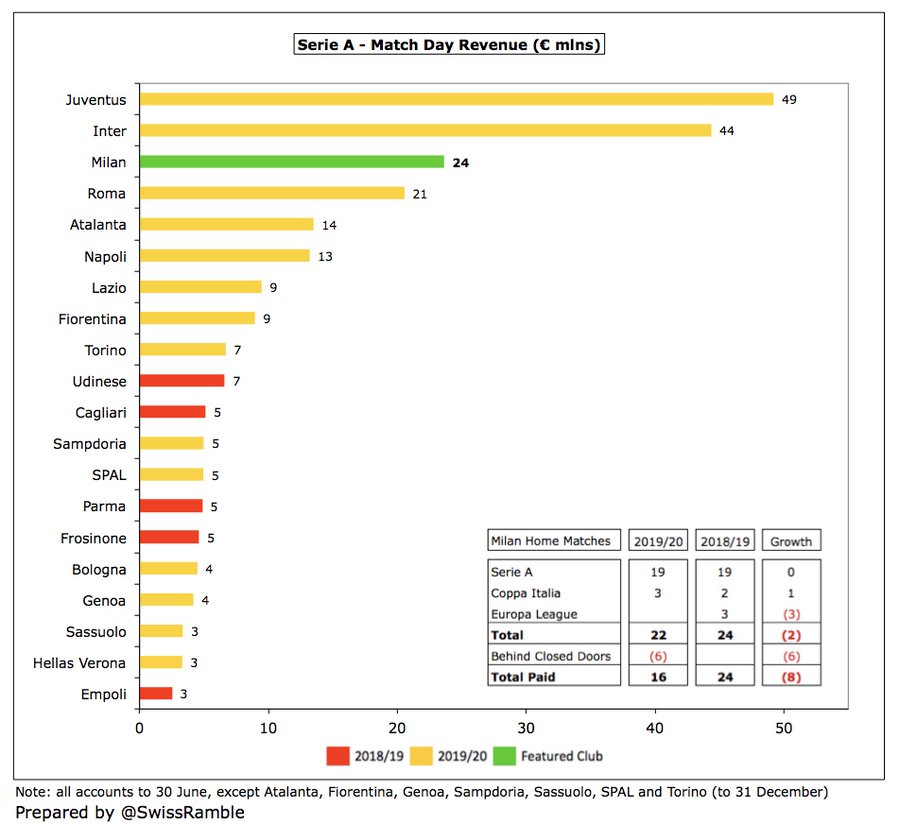
Match day Income refers to the revenue received by the club when a match is hosted at the San Siro. Milan’s matchday revenue reduced from 34M to 24M mainly due to Corona preventing fans from entering stadiums and Milan not participating in Europa League. Milan’s 24M was only better by Juventus (49M) and Inter (44M)
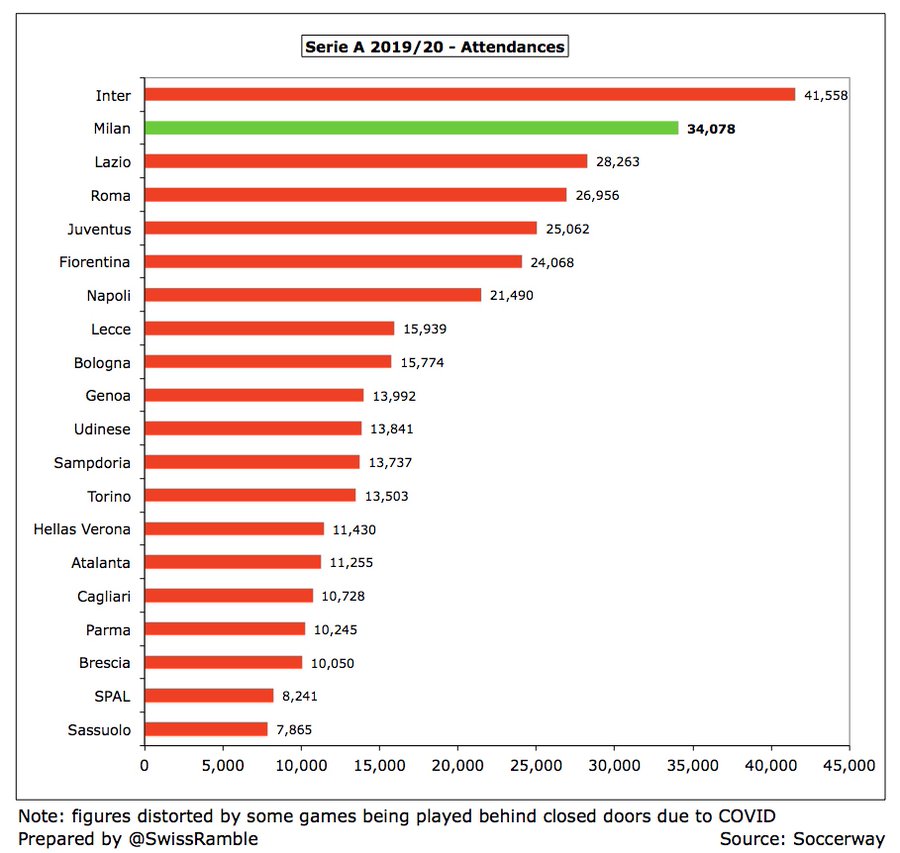
This is despite Milan having the second highest average attendance (34,078) in the league behind Inter Milan (41,558).
EUROPEAN PARTICIPATION
Each Team is given prize money for participating in Europe along with a share of the broadcasting revenue earned by UEFA. The share is determined by performance, historical performance in the competition.
Now this is a metric we all know the results even before the results was published. Milan’s total earnings from Europe was 0 from last season since Milan chose to sit out from Europa league and forego the minimum 15M it would have received from group stage participation.
Now a great divide can be observed in this respect of Milan with the bigger clubs. Juventus earned 87M from a Round of 16 exit in the UCL while Inter earned 57M from a group stage exit, while Atalanta earned 57M for a run towards the Quarters while Napoli earned 70M reaching the same stage.
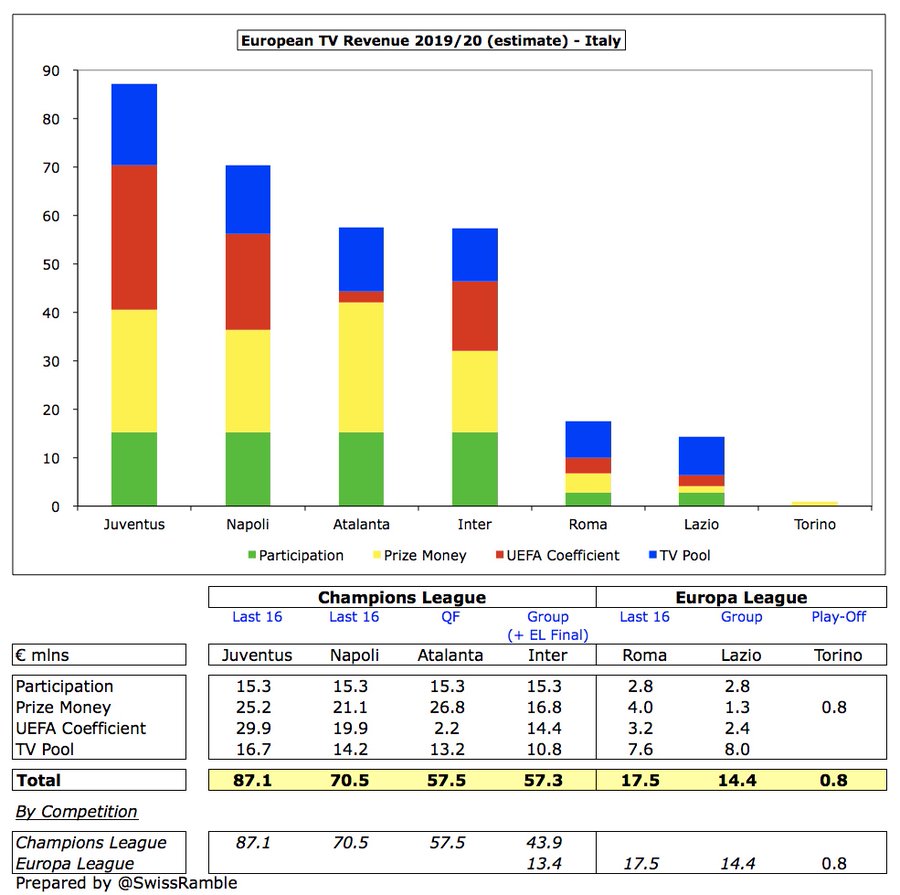
With Milan not having qualified to UEFA Champions league in the last 7 years Milan’s total prize money accumulated from European competitions is 29M (14M from 2017/18 and 15M from 2018/19). A comparison with Juventus, Roma and Napoli cannot be even thought of as consistent UEFA Champions league qualifications have earned them huge amounts of prize money+ tv pool.
TRANSFERS AND PLAYER METRICS
As a football club the main business of football clubs would revolve around dealing with football players. There are various costs and income involved with Football players and here we take a look at the performance of Milan under this overhead
Amortization, in layman’s terms, is transfer fee of a player that is spread across multiple years. It is a fictitious calculation used for accounting purposes to calculate accounting value of a player as well profit loss of a player when he is sold.
For example Hakan’s current Book Value is 2.8M. If Milan sell the player for 15M, Milan would make a profit of (15-2.8) = 12.2M

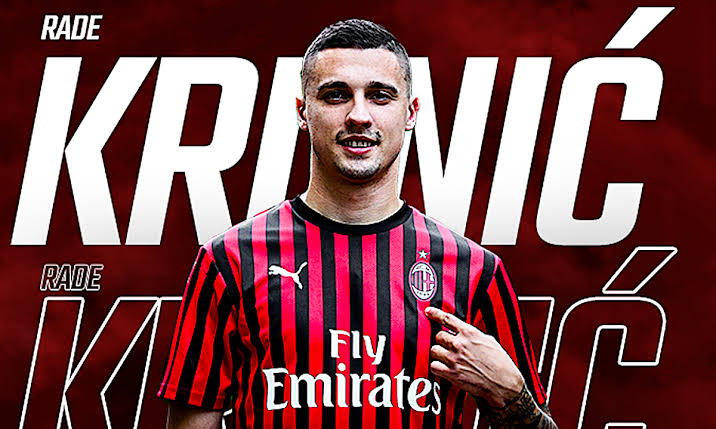
In the financial year of 2019/20, Milan’s total amortization player increased by 14M to 95M. This can be attributed to the fact that Milan spend close to 80M last season reinforcing the team for Giampaolo with purchases like Bennacer, Theo Hernandez, Leao, Duarte and Krunic. These purchases padded up along with the amortization costs of the players we bought under the Chinese by grossly overpaying.
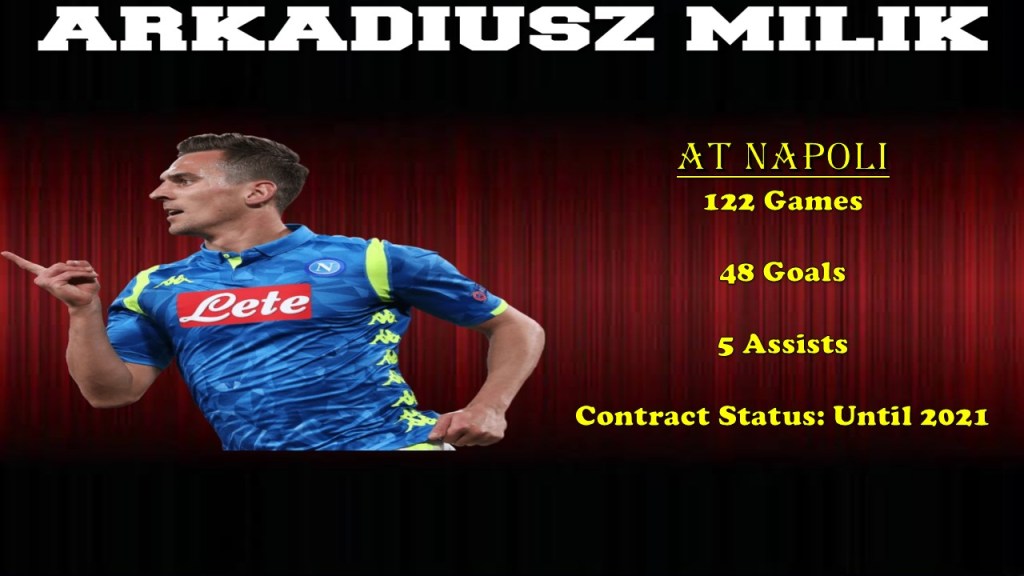
In terms of transfer Milan made a net profit of 15 Million. The sale of Cutrone for 17M and Djalo for 3M brought in 20M profit while the sale of Piatek and Borini gave a loss of 5M. When calculated net profit is 15M.
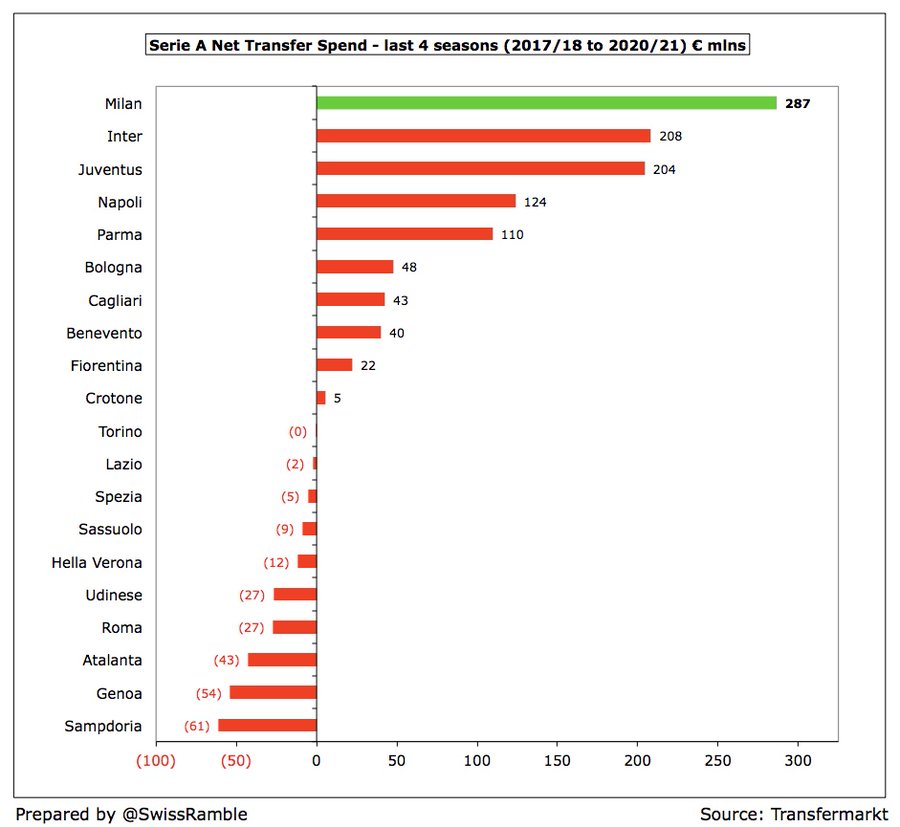
In terms of Net spend (Net spend is calculated as transfer fees paid minus transfer fees received) Milan has the highest Net spend in Serie A at 287M. This can be attributed to the terrible purchases commissioned under Mirabelli and Leonardo who squandered a lot of money meaning Milan spend 515M in the last 4 years. Compared to this the profit we have received from selling players is a paltry 72M.
While Juventus has the highest gross spend was 758M but the profit they made on player sales was 563 Million. This brought down their net spend to 195M hence showing better financial balances.
Milan’s transfer debts (transfer debt is amount owed by a club to the other club for the transfer of the player) reduced from 176M to 76M and now their net debt (amount to be paid minus amount to be received) is only 20M which is a very healthy financial indicator. Milans 76M gross debt is realtively less compared to Juve’s 301M, Roma’s 191M and Napoli’s 141M.
Another main source of income from transfer is loan fees and Milan collected 8M last season which is second highest in Italy behind Inter (9M) thanks to Icardi’s loan to PSG.
WAGE BILL
Wage Bill is often one of the most discussed and transparent overhead in the fan base. Milan’s wage bill was described as terrible one that needed a lot of attention by incoming CEO Gazidis.
Milan’s wage bill for the 2019/20 season fell by 24M (13%) thanks to players like Montolivo, Jose Mauri, Bertolacci, Bakayoko along with Borini, Caldara, Pepe Reina and Ricardo Rodriguez being taken off the wage bill mid-season. Despite this Milan has the 3rd highest wage bill in Serie A only behind Inter and Juventus.
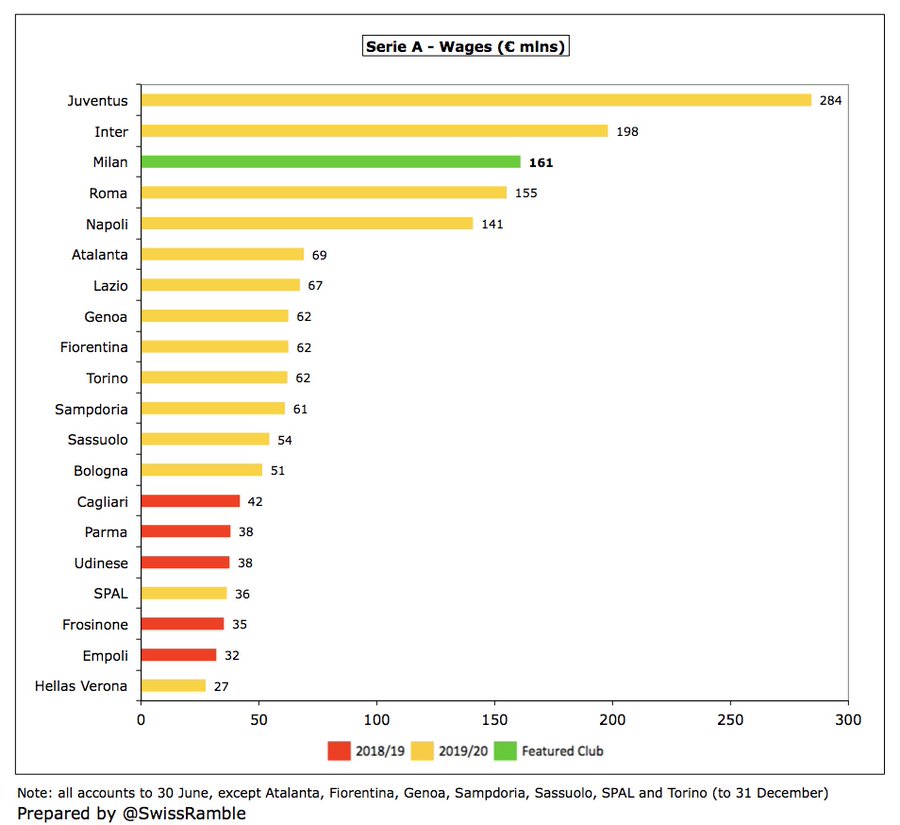
Wages to turnover ratio is a metric that is used by companies to measure the efficiency of the employees of the company. The lower the ratio the higher the efficiency. Milan’s ratio fell from 85% to 93% mainly because of overall fall in revenue. This is one avenue Milan fans will look to improve in the coming season.
COMMERCIAL REVENUE
Commercial revenue can be described as the revenue obtained by the club through various sponsorship activities and sale of merchandise.
Milan’s commercial revenue grew by a solitary 1M from the 2018/19 season. Despite Gazidis bringing in new sponsors Milan does not have quite the brand appeal of Juventus (186M) or Inter (142M) who have been qualifying for Champions league consistently and have household names such as Cristiano Ronaldo and Lukaku.
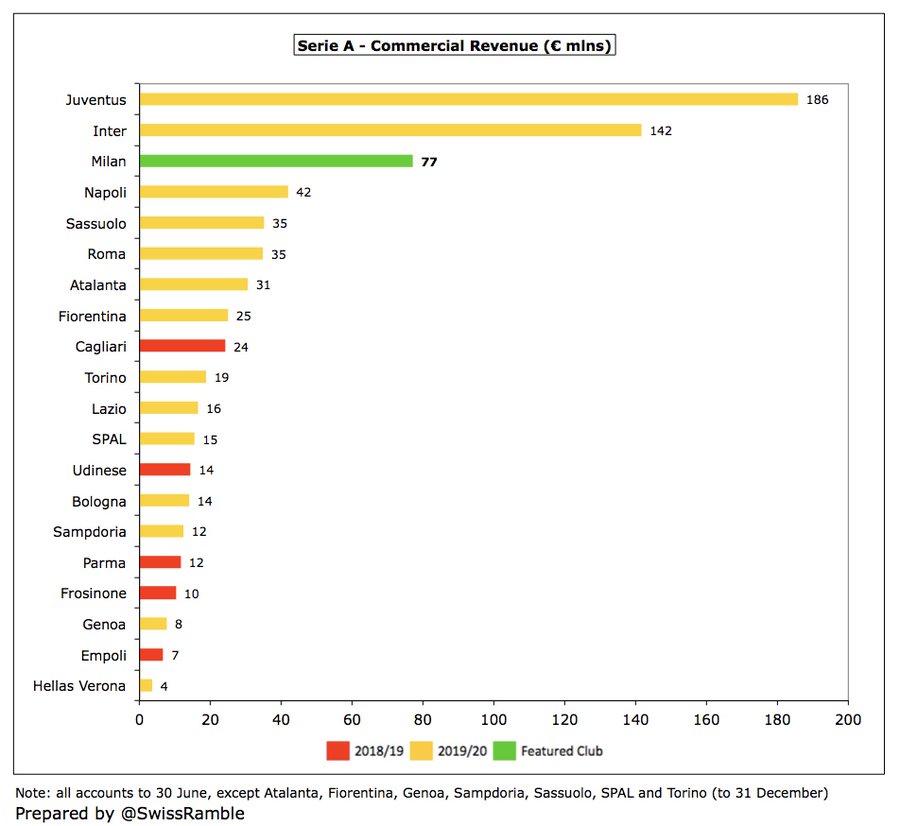
Milan’s Emirates sponsorship for their Jersey which was signed at 14M to be the exclusive sponsor has been reduced to 10M giving space for Milan to obtain sponsor on other areas of the shirt making it brim with commercial potential. It still however does not reach anywhere close to the 45M given by Jeep to Juventus.
DEBT
Debt can be described as the loan’s taken by the club through various means such as bank loans, unsecured loans (like the one taken by Yonghong Li from Elliot), loans from shareholders or bonds/debentures issued with financial institutions.
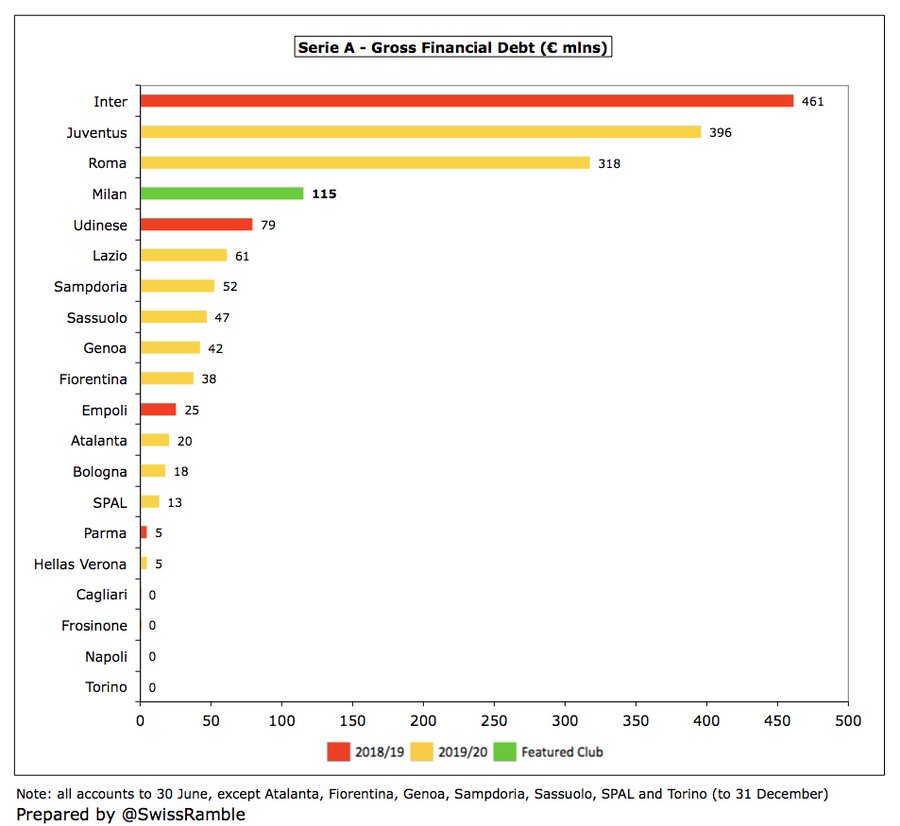
Milan’s gross debt increased by 19M from 96M to 115M due to a liquid cash loan taken with Unicredit (Unicredit is a company with links to Elliot) for future tv revenue factoring.
Milan’s debt to various shareholders and bank loans taken by Berlusconi and the Chinese were paid off by Elliot.
Milan’s 115M debt is in no way any close to the debts of other Serie A clubs with Inter having debts close to 500M, Juve 396M and Roma 318M. (Inter have yet to publish their accounts so the debt level is still unclear).
And like any other loan, clubs have to pay a certain dividend (Interest for bank loan). Milan’s net interest is only 6M while inter pays 23M, Juventus pays 15M and Roma pays 32M.
EFFECT OF COVID
Like the impact on all of our finances, Covid-19 has had an impact on Milan’s finances as well. A separate niche was assigned on the balance to consider the impact Covid-19 had on the clubs accounts.
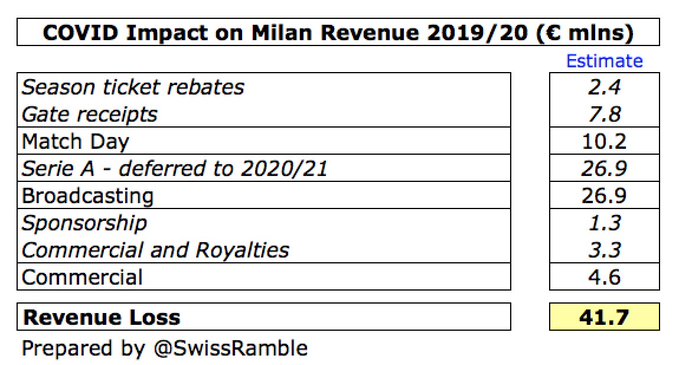
Milan have lost an estimate of 42M this season in which 26.9M is deffered (which means it will be added to the next financial year accounts because of payments received after July).
ELLIOT
A lot of fans have called into question the intentions of Elliot with regards to whether they plan to help milan achieve trophies or use them as a cash cow.
Under Ellliot Milanhave significantly improved their finances especially in terms of club debts and transfer debts.

Elliot invested close to 145M during 2019/20 season and 97M after the close of the 2019/20 season. They have in total invested close to 503M to revive Milan’s rather ailing account. It clearly shows Elliot are following the path to help Milan become financially independent.
Bringing down Milan’s gross debt from 220M under the Chinese to 115M at the end of the 19/20 season, Elliot deserve credit.
CONCLUSION
So what started off as a grim read seeing Milan having record losses at 195M, had light towards the end of the tunnel seeing some positive trends.
Milan’s expected matchday income of 34M per season is a very poor return for a club with an average attendance of 53,000 (without corona). Teams like Juventus or various EPL teams make double to what we make thanks to better stadium experiences and other commercial aspects inside the stadium. Milan and Inter’s joint project to build a new stadium is very crucial if both clubs want to compete with the financial bigwigs as well as the Premier League.
In terms of wages and transfers, Milan are still paying for the mistakes of the previous managements and will take years of corrective action. With Biglia, Reina, Suso off the wagebook a huge load off the wage bill is taken off and gives space for Milan to increase their wages to turnover ratio.
UEFA Champions league Qualification is the key to achieve financial (as well as sporting) wellbeing. Along with the Prize money, Tv Pool it brings prestige and attracts investors to invest in the club giving a boost to the commercial revenue side.
Last but not the least Milan need to be prudent with their transfer market activity. Milan would need to sell their players and replace them adequately. This for sure is a department fans wouldn’t worry about given how the 3M’s of Milan (Massara, Moncada and Maldini) have shown some cutting-edge technique to identify players and integrate them to build a winning side.


























 The Milan Blog